

Introduction to Sound Analysis
An introduction to bat call analysis using sound analysis software. We will use Wildlife Acoustics Kaleidoscope software (as this can be downloaded free of charge) and the analysis techniques covered will be applicable to a range of different programs. You will need to have access to a laptop or desktop computer.
As well as species ID we will look at the links between species’ ecology and call characteristics. Attendees will be given a library of recordings of bat calls to work through which they can keep afterwards for their own use.
Delivered online via Zoom by Philip Briggs, Monitoring Manager for National Bat Monitoring Programme (NBMP), this interactive workshop involves practical exercises. Agenda below.
Everyone is welcome
Bat Conservation Trust wants everyone to have opportunities to connect with bats and nature and get involved with conservation. We recognise that people of colour and racially or ethnically minoritised groups are particularly under-represented in the conservation sector. If this is relevant for you, please select the concession for under-represented groups when booking. Concessions are also available for BCT and bat group members, existing NBMP volunteers, students, and those who are unwaged.
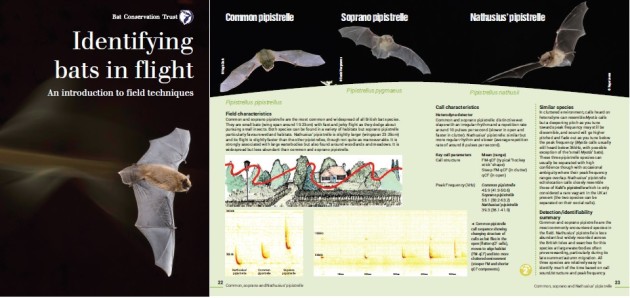
Identifying Bats in Flight (optional purchase)
This 28-page booklet introduces different types of bat detectors and gives an overview of field and call characteristics of UK bat species. However, it is not a requirement for the workshop and all attendees will receive a simpler PDF document showing species call shapes and call parameters.
If you have any questions, please get in touch with us at nbmp@bats.org.uk. Please read our Privacy Policy for workshop attendees.
Workshop outline:
Part 1: Introduction to bat sound analysis including overview of different bat detector systems, sound analysis software and overview of commonly used programs and visual representations of sounds (spectogram, oscillogram, power spectrum).
Hands-on training on identifying different UK bat species
Part 2: Identifying pipistrelles, noctule/leisler’s bat and horseshoe bats using call shape and peak frequency.
Part 3: Familiarising what are the additional call parameters and characteristics (e.g. call duration, interpulse interval, start and end frequencies) and how to measure these for identifying trickier species such as Myotis species, long-eared bats and barbastelle.
Part 4: Introductions to other sounds such as feeding buzzes and bat social calls.