

Labor in the Fight Against Fascism
Labor in the Fight Against Fascism
Share this event
*Sessions will run on consecutive Mondays from 4-6p PT | 6-8p CT | 7-9p ET*
**Registration requests a suggested donation based on income and/or organizational capacity. However, no one will be turned away for lack of funds.
Session Dates
- Monday, June 15
- Monday, June 22
- Monday, June 29
Center for Political Education invites labor leaders, organizers, and activists to join a special three-part study and discussion on how we transform the US labor movement into an antifascist fighting force.
As the MAGA administration decimates the rights and social welfare of the working-class and accelerates our trajectory into fascism in the US, veteran labor organizer and activist Bill Fletcher Jr. has challenged leaders across the labor movement to consider that the starting point for labor organizing in this period "must be that labor becomes an antifascist movement or it has no future."
This 3-part study will give labor leaders, organizers and activists a space to assess labor's response to the current threat, learn from and discuss the relevant history of labor in left-right dynamics in the US and globally, and strategize about how to overcome existing obstacles to labor and the trade union movement becoming an antifascist movement.
Sessions
Session 1: Labor on the Back Foot | June 15
Does the US labor movement understand the nature of the fascist threat? How do we explain its slow response to the Trump administration’s power grab, or the alignment with fascist ideologies that exist among trade union ranks? We’ll discuss how the US labor movement became disconnected from social movements and why it sometimes seems that “the interests of the working class conflict with the interests of the members of our respective unions.” We’ll measure the intensity of the far right threat, and how failures within the US labor movement led members to look to far right politics for answers.
Session 2: A Formidable But Beatable Opponent | June 22
Where did MAGA come from? What are its key strengths and what are the contradictions within far right movements that must be exploited? How does today’s neofascist movement fit within a long tradition in American and global politics,and what makes this moment new and distinct? We’ll uncover historical examples of labor’s effectiveness in fights against the far right, as well as labor’s class collaborationist mistakes. We’ll highlight the strategic role of labor in shaping the balance of power, through history and in the present moment.
Session 3: Getting into Fighting Form | June 29
How does labor become an antifascist and anti-far right force? In our final session, we’ll assess how to shift US labor movements towards antifascist political strategy. We’ll ask attendees to think together about what we do differently in our labor councils, formations, and coalition building. We’ll consider how we must change our tactical approach to collective bargaining, internal political education, and how we organize structures and decision-making in our labor movements. We’ll also identify key scenarios of fascist takeover that the labor movement must prepare for now, including political arrests and paramilitary violence.
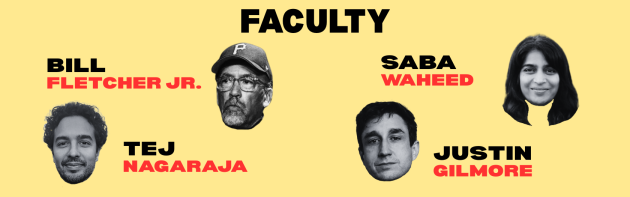
Faculty
Bill Fletcher Jr., is a long-time racial-justice, labor, and international activist, scholar, and author. A former shipyard welder, he has been involved in the labor movement for decades, and is a widely known speaker and writer in print and on radio, television, and the Web. He has served in leadership positions with many prominent union and labor organizations, including the AFL-CIO and the Service Employees International Union. Bill is the former president of TransAfrica Forum; a Senior Scholar with the Institute for Policy Studies; and in the leadership of several other projects. Fletcher is the co-author (with Peter Agard) of “The Indispensable Ally: Black Workers and the Formation of the Congress of Industrial Organizations, 1934-1941”; the co-author (with Dr. Fernando Gapasin) of “Solidarity Divided: The crisis in organized labor and a new path toward social justice“; and the author of “‘They’re Bankrupting Us’ – And Twenty other myths about unions.”
Tej Nagaraja is Assistant Professor of History at Cornell University’s ILR School. He received his Ph.D. from New York University, and has held fellowships at Harvard University, the New School and the New York Historical Society. His research and teaching explores the intersections of U.S. labor and African American and foreign relations history. Investigating both ‘top-down’ public policy and ‘bottom-up’ social movements, his work considers how class, gender and race evolve within a changing global division of labor and geopolitics. His newest book, Troop Movements (Penn Press 2026), explains how the mobilization for WW 2—involving soldiers and defense workers—created an anti-fascist mobilization across race, class, and global concerns that catalyzed the national and international political movements and conflicts of the postwar period. Many of these diverse war workers, he contends, led a “greatest generation” of labor, Black freedom, and anti-imperial social struggles, which linked racial and economic and international issues.
Saba Waheed is the director of the UCLA Labor Center. Prior to this role, she spent 11 years as the center’s research director. With nearly 20 years of experience developing community-led research projects for labor advocacy organizations, Waheed’s work is grounded in the “research justice” framework, which she co-developed to address structural inequities in research. In her time at the UCLA Labor Center, Waheed built the research infrastructure for, and led, more than 40 studies in partnership with low-wage workers. Among these was the first-ever study of domestic work employers, a multi-year study of workers and learners, and the first national study on nail salon workers and owners. She has also conducted research related to gig workers, young workers, Black workers, LGBTQ+ grocery workers, retail workers, fast food workers and restaurant workers.
Justin Gilmore is on the editorial board of Bay Area Current and teaches political theory at California State Stanislaus. His research brings together political theory, historical materialism, American political development, and social movement studies around questions of political power, resistance, and reaction. His current book project, tentatively entitled Latent Fascism: The Capitalist Origins of Reactionary Politics, develops a materialist political theory to understand how capitalist structures facilitate a persistent, latent fascist potentiality that can take many possible mature forms, including reactionary populisms that fall short of a clear-cut fascist identification. Justin teaches courses on ancient, early modern, and contemporary political theory; Marxism and class struggle; liberalism and conservatism; and the politics of fascism.