

EngBio Symposium & Forum
Note: Registration will close at 5pm,Wednesday 20 May.
Engineering Biology Interdisciplinary Research Centre Symposium and Forum - McGrath Centre, St Catharine's College
Our annual Afternoon Symposium (2:00–5:00pm) is a chance to celebrate and share the breadth of Engineering Biology research here in Cambridge. This year, Dr Jake Harris (Department of Plant Sciences) will speak on Programmable Plants, exploring how engineering plant systems can help address global challenges such as food security, sustainability, and climate resilience. The symposium will also feature four short poster talks selected from an impressive pool of submissions. A prize of up to £500 will be awarded to the best early-career talk to support conference attendance and related expenses.
At our evening Forum this term we are are spotlighting Metabolic Engineering—with speaker Professor Jay Keasling, UC Berkeley, USA. Metabolic engineering is a key area of modern engineering biology that’s driving progress in sustainable production, health, agriculture, and environmental solutions. The Forum brings together researchers from different areas to share ideas, swap perspectives, and explore how metabolic design is shaping the future of biological innovation.
Whether you’re new to Engineering Biology, presenting at our symposium, joining the discussion, or just coming along to learn and connect, we’re really looking forward to welcoming you to a lively and inspiring event.
Programme (subject to change) Thursday 21 May
EngBio Symposium
1.30pm Registration / Tea & Coffee
2pm – 2.30pm - Jake Harris ‘Programmable Plants – A major leap in plant biology’
2.30pm – 3.30pm – Poster Short Talks x 4 (15 mins each) with Gabrielle Admans (Pharmacology), Lise Boursinhac (Pharmacology), Maxwell J Hou (Chemical Engineering & Biotechnology) and Facundo Romani (Plant Sciences)
3.30pm – 4.30pm Poster Display Session with Tea, Coffee, Cake in Senior Common Room
EngBio Forum
4.45pm Registration
5.00pm – Welcome, Poster Talk Prize
5.15pm Keynote Speaker Jay Keasling
"Rewriting Plant Chemistry in Yeast: Securing the Supply of Life-Saving Medicines"
6.00 pm Questions and comments
6.15pm - 7.00pm Networking, Buffet
Talk Abstracts
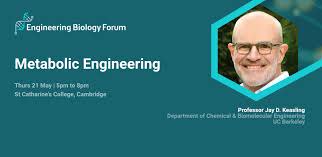
Rewriting Plant Chemistry in Yeast: Securing the Supply of Life-Saving Medicines
Jay Keasling, Department of Chemical & Biomolecular Engineering
University of California, Berkeley
Plants produce many of the world’s most important medicines, including anticancer
agents, vaccine adjuvants, and other highly complex natural products. Unfortunately,
these molecules are often available only in trace amounts from slow-growing or
geographically constrained plants, making their supply fragile, expensive, and difficult to
scale. Synthetic biology provides a complementary solution: rebuilding plant
biosynthetic pathways in microbial hosts to enable reliable and sustainable production.
In this talk, I will describe our long-standing efforts to refactor complex plant natural
product pathways into Saccharomyces cerevisiae, effectively transforming yeast into a
platform for the manufacture of life-saving medicines. By reconstructing long, multistep
pathways that span terpene, alkaloid, glycosylation, and polyketide chemistry, we have
shown that yeast can support dozens of heterologous enzymatic reactions starting from
simple carbon sources. Achieving this requires extensive rewiring of host metabolism to
balance precursor supply, redox chemistry, cofactors, pathway flux, and enzyme
compatibility.
As case studies, I will highlight the microbial biosynthesis of monoterpene indole
alkaloids related to vinblastine and triterpene saponins related to the vaccine adjuvant
QS-21. These pathways represent some of the longest and most chemically
sophisticated ever reconstructed in a microorganism, involving large numbers of plant
cytochrome P450s, glycosyltransferases, and polyketide synthases.
Beyond reproducing natural products, this work enables diversification. Enzyme
promiscuity, pathway modularity, and engineered precursor pools provide access to
families of analogues that are difficult or impossible to obtain from plants or chemical
synthesis alone. Together, these advances position engineered yeast as both a
scalable manufacturing platform and a powerful engine for expanding the chemical
space of medically important natural products.
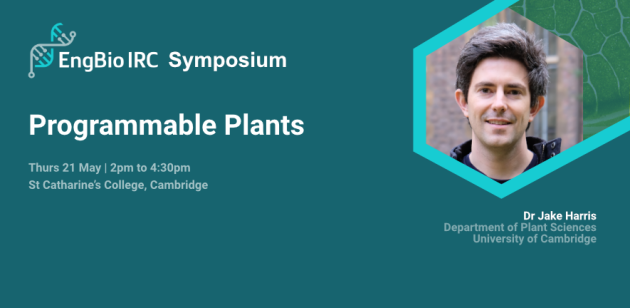
Programmable Plants – A major leap in plant biology
Jake Harris, Dept. of Plant Sciences, University of Cambridge
Growth patterns, stress tolerance, and soil nutrient uptake are plant traits that are critical for improving food security and climate resilience. These traits are determined by plant chromosomes, structures that contain genetic ‘instructions’. Historically, our ability to influence these chromosomes has been limited. Jake + team seek to tackle this challenge by laying the foundations for delivering large and complex sets of chromosomes into crop plants. Their goal is to build and deliver a large piece of DNA, approximately the size of a million genetic ‘letters’, into the potato, as a synthetic plant chromosome. Jake + team believe that creating these chromosomes and delivering them into plants will unlock the ability to access and improve virtually any plant characteristic, which could have transformative benefits for the global food system and beyond.
About the EngBio Forums
The Engineering Biology Forums are a series of talks exploring key tools for the future of engineering biology and biotechnology. Hosted by the Engineering Biology Interdisciplinary Research Centre at the University of Cambridge, the forums take place 5pm-7.30pm at St Catharine's College, Cambridge. Keynote lectures and discussion session will be followed by food, drinks and networking.
Cancellation and No-shows
If your plans change and you’re unable to attend, please let us know as soon as possible. We have a waiting list and must confirm catering numbers with the venue a week in advance. Your prompt notice helps us reduce food waste and offer your place to someone else. Thank you so much for your understanding.
Location
St Catharine's College, Cambridge, CB2 1RL