

Galloway Field Meeting: James Hutton's Journey to the South Alpine parts of Scotland in the year 1786
Galloway Field Meeting: James Hutton's Journey to the South Alpine parts of Scotland in the year 1786
Share this event
Need help?

2026 Hutton Tercentenary: Galloway Field Meeting
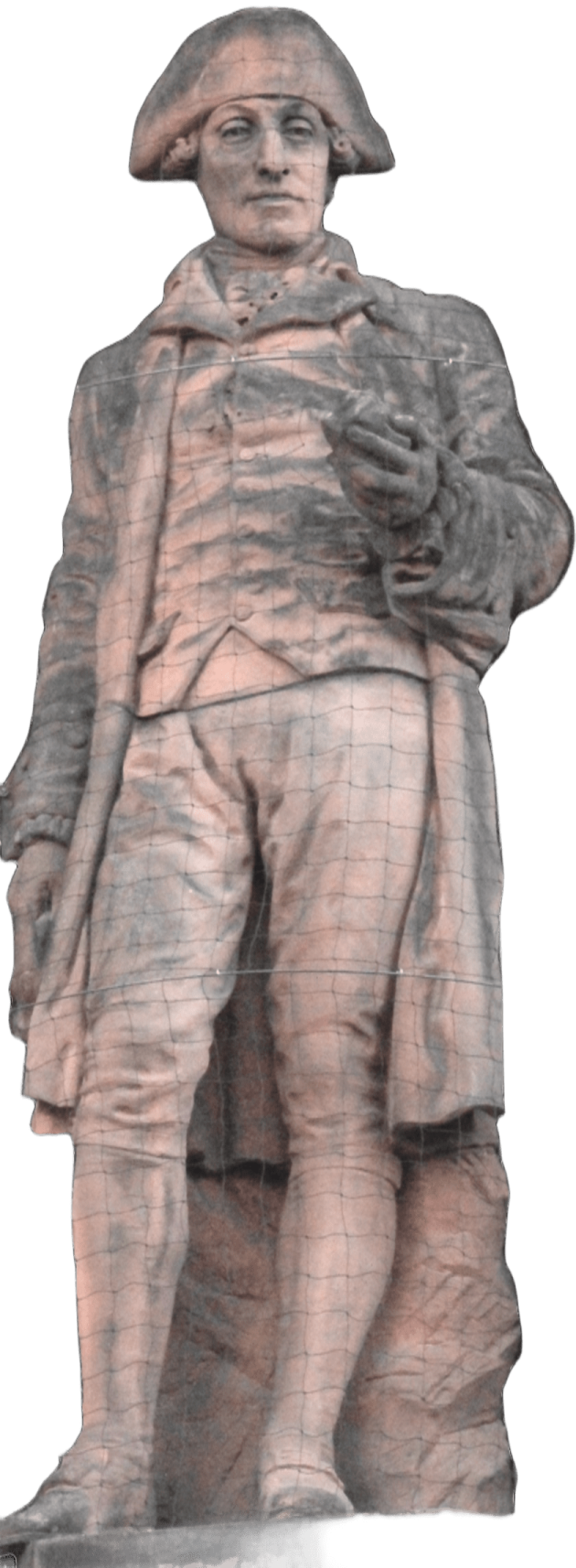
Journey to the South Alpine parts of Scotland in the year 1786: locations in search of proofs for ‘Theory of the Earth’
Dates:
Arrive: Sunday 20 September 2026
Field days: Monday 21 September – Wednesday 23 September 2026
Purpose and Background
This field meeting is a contribution to commemorate the tercentenary year of Hutton's birth (1726) - and, importantly, will follow in his footsteps on his ‘Observations made in a journey to the South Alpine parts of Scotland, in the year 1786’
Hutton undertook this journey, in September, with his friend, John Clerk of Eldin as his companion, in order to search for ‘Proofs and Illustrations‘ of his ‘Theory of the Earth’ that Hutton intended to publish as Volume 3 in his planned four volume work. Clerk of Eldin, a notable artist, was to provide the illustrations.
In the event, only the first two volumes were published (in 1795). The third volume, in manuscript, was eventually published just over a century after Hutton’s death, but without the illustrations. These were not discovered until 1968 at the Clerk’s family home in Penicuick, just south of Edinburgh.
This meeting will retrace Hutton and Clerk of Eldin’s journey through Galloway, where they thought they might discover evidence of the nature of the contact between granite and ‘schistus’ to indicate the ‘fiery’ origin of granites. Our journey will take place exactly 240 years (to the week) after Hutton’s venture.
This re-creation of this journey has never been undertaken previously, nor have many of the sites they visited been previously identified and located.
Both Hutton’s account from his Volume 3 manuscript and the notes and sketches in Clerk of Eldin’s diary of the journey will be used to follow their route and observations.
A key (historical) aim of this meeting will be to compare the source descriptions and drawings of sites with the field exposures and evaluate how 'accurate' Hutton's observations were - or if they were 'stretched' to be presented as evidence to fit his theory.
In particular we will examine locations that match Clerk of Eldin’s drawings and evaluate to what extent they are a faithful, accurate, record, or whether they are drawings made in the style of the period (late 18thC), or if they exaggerated and/or emphasised some features in order to bolster Hutton’s ideas and arguments.
Convenor and Leader: Duncan Hawley
Duncan is co-author (with Tom Sharpe) of the chapter ‘Milestones in the history of Scottish Geology’ in ‘The Geology of Scotland’ (5th edition, 2024). He wrote the section on the Edinburgh early influential figures: James Hutton and Robert Jameson.
Duncan is a resident of Galloway (for much of the year) and has made a first-hand study of the locations that Hutton visited on his journey to the area including sites not previously located. He is a geoscience and geography educator (retired but still active), and is the Chairperson of HOGG.
Itinerary
Participants will arrive on Sunday 20th September, with an evening briefing (background to Hutton and his tour) and talk outlining the geology of the area.
Visits to fiield sites will begin on Monday 21st September.
Day 1 (Monday 21st) will start in Newton Stewart with an introductory briefing, then journey to Palnure, Creetown, Cairnsmore of Fleet (National Nature Reserve) and Gatehouse of Fleet.
Day 2 (Tuesday 22nd) will start in Kirkcudbright, then journey via Tongland, Auchencairn, Dalbeattie, Sandyhills Bay, Arbigland and New Abbey to Dumfries.
Day 3 (Wednesday 23rd) will start in Dumfries Museum, with a briefing and viewing of the earliest discovered specimen of fossil footprints, in New Red Sandstone, then departing on the final leg of Hutton’s journey to Locharbriggs (quarry), with a visit to Corncockle Quarry (site where the footprints were found, visited by WIlliam Buckland, and Sedgwick and Murchison), then on to Moffatt and Ericstane, where Hutton and Clerk of Eldin quit the red sandstone and “fell in with the Schistus”.
A final visit will be made to the nearby site of Dob’s Linn, where Charles Lapworth’s pioneering approaches using graptolite biostratigraphy unravelled complex successions and structural geology. This inspired him to propose the Ordovician System in 1878, solving the controversial issue of the Cambrian–Silurian boundary. Dob’s Linn is also designated the Global Stratotype Section and ‘golden spike’ Point for the boundary between the Ordovician and the base of the Silurian Period.
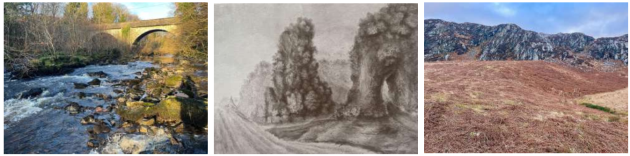
The itinerary may be subject to change, depending on weather conditions and site accessibility.
Outdoor considerations
Most sites are within easy walking from car parking but please note:
Cairnsmore of Fleet is an upland hill site on open ground, about 30 minutes upslope from parking, on paths over mainly rough grassland terrain, returning via the same route.
Sandyhills Bay is across a wet, sandy tidal flat (low water), about 20 minutes walk (each way), open to the Solway Firth.
Arbigland is a walk of about 20 minutes (each way) along the wooded cliff path and shoreline, open to the Solway Firth.
Dob’s Linn is an upland valley, about 20 minutes from car parking, crossing grazed slopes with boulders and a streamside path.
Galloway and southwest Scotland can be wet (Hutton and Clerk were delayed for one day by rain), so good waterproof clothing should be carried. However, it can also be gloriously sunny!
Sturdy footwear is essential - (waterproof) boots are fine for the hill and coastal sites.
All visited sites are risk assessed using the HOGG Field site risk assessment scheme.
Transport
The itinerary will be followed using car transport.
Car sharing will be preferable, as some sites have limited parking (otherwise a significant walk to the sites will be required) and will be organised as appropriate.
Distances
Newton Stewart (starting point Day 1) to: Gatehouse of Fleet = 18 miles, Kirkcudbright = 25 miles, Castle Douglas = 30 miles.
Day 1 = 25 miles.
Day 2 = 45 miles
Dumfries (starting point Day 3) to: Gatehouse of Fleet = 34 miles, Kirkcudbright = 27 miles, Castle Douglas = 18 miles
Day 3 = ca. 45 miles + 15 miles to Dob’s Linn.
N.B. Creetown (visited on Day 1) has a fuel station with very low prices.
Evening arrangements
Hutton enjoyed a convivial dinner and evening.
It is anticipated that evening 'social' supper/dinner venues will be arranged - for those who wish - in one of the eateries/hostelries in one of the towns or surrounding area.
Accommodation
Participants are expected to arrange their own accommodation.
A websearch or popular booking site e.g. Booking.com is recommended.
It is suggested that any of the towns or surrounding area of Gatehouse of Fleet, Kirkcudbright or Castle of Douglas will be convenient as centres of accommodation for the meeting. All are very pleasant towns that have a number of good hotels, B&B facilities or self-catering accommodation, to suit a range of tastes and pockets.
Gatehouse of Fleet is a delightful late 18th century planned town at the head of a canalised estuary, originally built as a cotton mill town - it lost out to bigger ventures in Glasgow and Lancashire. Hutton and Clerk visited here and remarked on the mill and Cardoness castle on the edge of the town
Kirkcudbright is on a tidal estuary and has a small quay, with a couple of active fishing boats and a ruined castle. Hutton and Clerk stayed here for two nights.
Castle Douglas is another interesting planned town with Carlingwark Loch on the edge. Hutton and Clerk visited the area and remarked on the deposits in the loch but the town was not yet built; being founded in 1792.
Dumfries is the county town, where Robert Burns lived. It has a more urban feel than the other towns, and is a suitable accommodation base for Days 2 and 3 but lies a distance from the Day 1 sites.
Newton Stewart is on the western fringe of the field area and is the starting place for the Day 1 journey, but is a 40 minute+upwards journey to the Day 2 and Day 3 sites.
Wigtown, a further 12 miles south of Newton Stewart, is the booktown of Scotland (at least 10 bookshops) and a delightful little town. Some participants may wish to stay in that area but they will have a longish journey to and from the itinerary route.
Getting to the Area
Car
Journey by car is relatively easy via the M6 Motorway north to where it becomes the A74(M) just over the England/Scotland border, then exit immediately (Junction 22, Dumfries & Stranraer) onto the A75. Follow the A75 west to the field area.
For those without their own transport:
The usual practice on HOGG field meetings is to use car transport to travel between locations (as indicated above). However, this does not debarr participants who do not have a car - we will arrange car-share.
Arrangements can be made for non-car participants - including meeting on arrival at rail stations, pick-up at the start of the day and dropping near accommodation at the end of each day.
Rail
Regular trains run from Manchester to Lockerbie .
Transport to accommodation in the field area can be organised by arrangement, and will meet the 16.30 or 16.37 trains (Lockerbie arrival) on Sunday 20th September.
Trains also run from Manchester to Dumfries, requiring a change at Carlisle where connecting trains run every hour to Dumfries.
Air (for international participants)
Manchester Airport is the easiest option, then take the train to Lockerbie (direct trains from the airport station).
Transport to accommodation in the field area can be organised by arrangement, and will meet the 16.30 and 16.37 trains (Lockerbie arrival) on Sunday 20th September (assuming no timetable changes).
Flights to Glasgow and Edinburgh airports are also possible but these do not link directly to the area, requiring an extra journey to the central rail stations to change for the ongoing train to Lockerbie.
Post-trip visit possibilities
Arran - Hutton and Clerk of Eldin visited the Isle of Arran in 1787, and a day visit has been organised. This will be an early start to Adrosson, crossing on the ferry, transport by community minibus to the north coast (Loch Ranza unconformity) and east coast (Tomore dykes) to view important history of geology sites (also viewed by Robert Jameson), and the return ferry to Ardrossan. Costs will be share of car fuel, ferry passenger return fare £10.60 and share of minibus cost (estimated at £10 per person). These will be payable on the day of the trip.
Visit to the famous Jedburgh Hutton unconformity (1787) and the probable site, near Hawick, where Hutton confirmed the discovery at Jedbugh.
Historic site of the first recognition of a feature formed by glacial ice in Britain, by William Buckland in 1830, with the scenic Crichope Linn gorge.
Stranraer and the Rhinns of Galloway- the site where the occurrence of graptolites in the slate (greywacke) of Scotland were first discovered (1838), and Hutton’s journey in southern Ayrshire and western Galloway coast (which preceded his main studies in Galloway)
Galloway is a delightful area of varied coastal, rural and mountain scenery to entice visitors to enjoy the region for a few days on their own terms.
Field Meeting Fee:
£20.00 per person, to include a field guide.
Please note that the Sandyhills site visit will involve a car parking fee of £6, to be shared by drivers and passengers. Any other car parking fees incurred will be shared by car occupants.
Detailed joining instructions will be issued to registered participants one week before the start of the meeting.
For queries or further information contact Duncan Hawley at: duncan.hawley.hogg@gmail.com
Location
Dumfries & Galloway, DG7