

A More Inclusive Data Science (Online)
About this event
There are many ways that Data Science can be made more inclusive, from building more inclusive teams to the types of data we collect and how this data is communicated. During this session you will hear from speakers who will discuss some of the ways that data science can be made more inclusive from recruitment to research design.
Please look at our Code of Conduct which we follow at all virtual and in-person events.
Programme:
12:00 – 12:05: Introduction
12:05 – 12:15: Professor Catherine Hobbs
12:15 – 12:25: Amy Gallimore
12:25 – 12:35: Dr Rachel Dugdale
12:35 -12:45: Dr Betsy Muriithi
12:50 – 13:00: Questions and Discussion
Speakers
Professor Catherine Hobbs, Chair of the Heilbronn Institute for Mathematical Research, University of Bristol
Amy Gallimore, The Alan Turing Institute EDI Strategic Lead
Dr Rachel Dugdale, Founder/Director at Complexical
Dr Betsy Muriithi, Research Fellow, @ilabAfrica Strathmore University
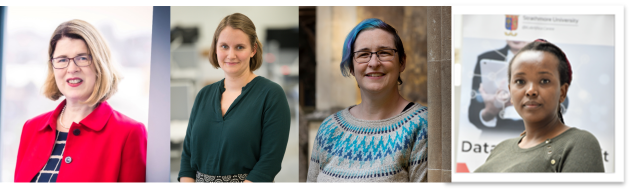
Left to right: Catherine Hobbs, Amy Gallimore, Rachel Dugdale and Betsy Muriithi
Professor Catherine Hobbs (she/her)
Professor Catherine Hobbs is a mathematician who has worked in several universities in the UK and overseas over the last 30 years. During her career she has held a number of leadership roles including Head of Department and Dean of Faculty. She has held a long interest in diversity in STEM disciplines. As founding Chair of the London Mathematical Society’s Committee on Women in Maths (now Committee on Diversity and Women in Maths) she initiated the production of reports on the mathematics pipeline as well as other diversity initiatives such as Women in Maths events and a prestigious annual lecture named for Dame Mary Cartwright, the first female president of the London Mathematical Society. The work of the Committee earnt the LMS the inaugural Royal Society Athena Prize for its contribution to good practice and the advancement of diversity in STEM in 2016. Catherine is currently the Chair of the Heilbronn Institute for Mathematical Sciences, and a professor at the University of Bristol. She also leads on policy for the newly formed national Academy for the Mathematical Sciences.
Amy Gallimore (she/her)
Amy Gallimore is Equality, Diversity and Inclusion Strategic Lead at the Alan Turing Institute, the UK’s national institute for Data Science and AI, where she leads on the delivery of the Institute’s EDI Strategy. Prior to this, she worked with both students and Fellows implementing a range of measures to encourage diversity and inclusion. She has a background in working with young people in roles across education and charities with a particular focus on supporting special educational needs and disabilities.
Dr Rachel Dugdale (she/they)
Dr. Rachel Dugdale is founder of Complexical and a computer scientist with over 18 years professional experience in a variety of research, technology, and leadership roles. Her experience spans applications of AI and machine learning, natural language processing, knowledge representation, privacy-enhancing technologies, blockchain, and cyber security, with a focus on the interplay of technical, organisational, and human factors. She was awarded “100 Women in AI Ethics” for 2024 for her work in explaining AI to non-technical audiences.
Dr Betsy Muriithi (she/her)
Dr Betsy Muriithi is an analytical researcher in Health and Business. She is a MSc. Data Science and Analytics lecturer specializing in Business Intelligence. Her research interests focus on experimenting and developing ways in which data can be used to create insights that drive improvement in social service delivery. She has worked on several projects including developing a carbon calculator tool to model Kenya’s energy system and future carbon pathway scenarios to decarbonisation, digital climate advisory chatbot for farmers, consulted on COVID-19 preparedness in Kenya. Additionally, she spearheads initiatives to build the skills of early career researchers in data science.
Talks
1. Women in Mathematical Sciences, Professor Catherine Hobbs
In this talk I will present data about the mathematical sciences pipeline in the UK, from A level through to PhD. I will include some remarks about the contrasts with other disciplines in the UK and with mathematical sciences in other countries, and how Data Science as a relatively new discipline has the opportunity to be inclusive
Audience level:
Beginner
Learning outcomes:
1. There is a leaky pipeline for women coming into the mathematical sciences;
2. There is little objective evidence that this is related to lack of mathematical ability;
3. Data science has the potential to be a more inclusive discipline than other mathematical sciences areas from the start.
2. Successes and Challenges in delivering an EDI Strategy
The profile of equality diversity and inclusion has risen considerably over the last few years with many organisations busy delivering on their EDI Strategies. This work undoubtedly builds on years of hard work by individuals and teams who have long been championing diversity and inclusion. In this talk I will reflect on the Alan Turing Institute’s experiences as a relatively small, new research institute in delivering our first EDI Strategy. As well as general themes, I will present several case studies where things have, and haven’t worked in our efforts to create a more inclusive research institute.
3. Navigating LLMs' First Impressions of Us, Dr Rachel Dugdale
As humans, we’re all familiar with the unreliability of first impressions, which are often based on surface-level information – such as gender and race, accent, or appearance. But as humans, we also have the cognitive flexibility to react and adapt when our first impressions are challenged.
Large language models have captured an entire internet’s-worth of first impressions, assumptions, and stereotypes, and encoded them into hard statistics. At the same time, research has shown that LLMs are inferring private demographic data about the people who use them, even though no-one has specifically trained them to do that. Language isn’t neutral, and how you talk (or write) gives away a lot about who you are, even when you think you’re anonymous. Although the chatbots built on top of LLMs seem responsive to prompts, they don’t have the ability to truly learn by updating their underlying models when they encounter something unexpected, meaning they’ll make the same ‘first impression’ errors over and over again with different people.
This talk will look at the ways generative AI’s “assumptions” can show up in the real world, and how this affects their outputs – and our outcomes. We’ll also explore some ways we might start to build tools to compensate for AI’s biases.
4. Integrating Equality, Diversity, and Inclusion in Agri-tech Innovations: Lessons from Deploying IoT and AI Mini-Weather Stations in Busia Count, Dr Betsy Muriithi
In the fight against climate change, technology offers significant tools for adaptation and resilience, particularly in the agricultural sector. However, the successful implementation of such technologies frequently hinges on their accessibility and relevance to diverse user groups. This presentation will delve into a pioneering project that used Internet of Things (IoT) and Artificial Intelligence (AI) to support smallholder farmers in Kenya, with a strong focus on women-led farming groups who are disproportionately affected by climate challenges. We will explore the inclusive design principles that were integral to the project, ensuring that the technology developed was not only advanced but also accessible and useful for all members of the community.
The talk will outline the project's approach to stakeholder engagement, which involved local farmer groups in the co-design of weather stations, ensuring that the tools developed were tailored to their specific environmental and socio-economic contexts. Special attention was given to gender dynamics, addressing barriers that typically hinder the participation of women and other marginalized groups in technology-led interventions.
Audience level:
Beginner
Learning outcomes:
Key lessons and best practices from the project will be shared, providing insights into how similar principles of inclusivity can be applied to other technology-driven projects. This talk aims to spark a broader discussion on the critical role of EDI in designing and implementing technological solutions in agriculture and beyond, highlighting the imperative to develop systems that truly serve the needs of all users, particularly those most vulnerable to global challenges.
Bristol Data Week 2024
This event is part of Bristol Data Week 2024, organised by the Jean Golding Institute. Running from Monday 3rd June – Friday 7th June 2024, this will be our 7th annual Data Week; an interactive programme of speakers, training and workshops open to all and completely free of charge.
Keep up to date with sessions happening throughout Bristol Data Week on the Jean Golding Institute website follow us on Twitter @JGIBristol and use #BristolDataWeek.