
Conversations in Living Room : with Dr Jennifer Mullan
Conversations in Living Room : with Dr Jennifer Mullan
Share this event
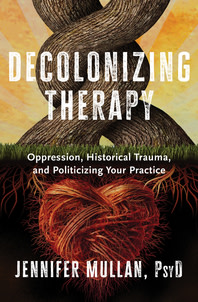
Decolonizing Therapy - Oppression, Historical Trauma and Politicising Your Practice.
“Decolonizing therapy is looking at the entire individual. It's putting a focus on how trauma from oppression and the history of colonization has played a role in people's well-being and mental health. It’s realizing that we cannot just look at an individual without looking at what is happening systemically as well.”
Check times in your time zone : time zone
Dr. Jennifer Mullan (she/her), affectionately nicknamed “the Rage Doctor” by peers and clients, is trained as a Clinical Psychologist, is a published author, and is the CEO and founder of Decolonizing Therapy. She seeks to unpack the oppressive legacy of modern mental health practices, and reconnect practitioners and clients to the roots of our wounding and healing within a sociopolitical lens, most particularly for Queer Indigenous Black Brown People of Color (QIBPOC). (website).
To order Decolonizing Therapy follow the links:
The publisher of Dr Jenn's book has now set up a discount code which is WN119 and is offering a 35% discount when books are ordered through the UK site. It is valid until the end of the year. The link to the site is https://bit.ly/3Ojk0ga.
Purchasers have the option to add the code after they have placed the book in their shopping basket which then applies the discount.
You can also get a digital download from:
https://books.apple.com/gb/book/decolonizing-therapy-oppression-historical-trauma-and/id6444164820
About the book:
A call to action for therapists to politicise their practice through an emotional de-colonial lens
An essential work that centres colonial and historical trauma in a framework for healing, Decolonizing Therapy illuminates that all therapy is—and always has been—inherently political. To better understand the mental health oppression and institutional violence that exists today, we must become familiar with the root of disembodiment from our histories, homelands and healing practices. Only then will readers see how colonial, historical and intergenerational legacies have always played a role in the treatment of mental health.
This book is the emotional companion and guide to decolonisation. It is an invitation for Euro-centrically trained clinicians to acknowledge privileged and oppressed parts while relearning what we thought we knew. Ignoring collective global trauma makes delivering effective therapy impossible; not knowing how to interrogate privilege (as a therapist, client or both) makes healing elusive; and shying away from understanding how we as professionals may be participating in oppression is irresponsible.
About the panel of speakers who will be each be responding to chapter 8 of the book in dialogue with Dr Jennifer Mullan.
You will find links to some of the published work and writings of the panelists in their bios.
We will then open up the space for contributions from participants.
You may wish to read the chapter ahead of the event.
Chapter 8 : Collective Grief and Sacred Rage as Expressions of Colonisation.
The panel's current reading/listening/viewing companions
Dr Gail Lewis : is an author, academic and psychoanalytic psychotherapist. Her political subjectivity was formed in the intensities of black feminist and anti-racist struggle and through a socialist, anti-imperialist lens. She was a member of the Brixton Black Women's Group and one of the founder members of the Organization of Women of African and Asian Descent, Britain’s first national organization for black and other women of color. She organizes her thinking through the category ‘experience’ which she conceives as a vector of both the felt senses in conjunction with social, structural and cultural processes, and an analytic in the production of meaning and knowing otherwise. She is currently writing a book on Black feminism in Britain and has written on feminism, intersectionality, the welfare state and citizenship, psychoanalysis and Black feminism, and the psychosocial dynamics of racialized-gendered experience.
Her publications include ‘Race, Gender and Social Welfare: encounters in a postcolonial society’ (2000), Polity Press; ‘Citizenship: personal lives and social policy’ (2004), ed. Polity Press; ‘Birthing Racial Difference: conversations with my mother and others’ (2009) Studies in the Maternal; ‘Unsafe Travel: experiencing intersectionality and feminist displacements’ (2013) Signs: journal of women in culture and society; ‘Where Might I Find You’: Popular Music and the Internal Space of the Father’, (2012) Psychoanalysis, Culture and Society; ‘Questions of Presence’, (2017) Feminist Review, Issue 117; ‘Black Feminism and the Challenge of Object Use’ (forthcoming) Feminist Review. She believes that open and honest conversations across differences, including intergenerational conversations, are the pressing issues of this moment of hate-filled crisis. She is an Arsenal fan. https://www.versobooks.com/en-gb/blogs/news/4840-revolutionary-feminisms-gail-lewis
Foluke Taylor : therapist*writer, working with an asterisk to signal black feminist modes of creation, space-making, and care. She is interested in facilitating emergence – in the what-is-not-yet-but-is-coming-to-be and the therapeutics that usher it in to being. Foluke is the author of How the Hiding Seek (2018) an experiment with the intermediary agency of creative writing to counter hierarchy, categorical difference, and separation. She is a troubler of borders including, but not limited to, those erected between mind/body, human/ ‘nature’, now/then, and fiction/non-fiction. After spending several years doing some adult growing up in The Gambia, Foluke returned, with her partner and children, to the city of London where she is now based. Unruly Therapeutic: Black Feminist Writings and Practices in Living Room, was published by W.W. Norton in 2023. https://youtu.be/D79lAfm8eik?si=Ojvd2ZLaoKsBImdl. Unruly Therapeutic on substack. Black Feminist Friends.
Nic Frealand : is a Child and Adolescent Psychoanalytic Psychotherapist working in private practice.
He previously trained and worked for Child and Adolescent Mental Health Services [CAMHS] in the UK’s National Health Service [NHS] before leaving to co-found a worker-cooperative therapy practice in south-east London. This is formed of 12 therapist and counsellor members of The Black, African and Asian Therapy Network [BAATN] and is currently in its development phase.
As a worker cooperative, fellow founders practice directly-democratic, consent-based, decision making which honours their existential need for equity, solidarity, self-determination, self-care and community investment. They have been drawn to cooperativism by a need for financial transparency in therapy industries that ordinarily exploit therapists’ lack of capital/s: financial, social or cultural. Their mission is to responsibly explore options for alternative sources of income and ways to broaden access to our services in response to the ongoing intensification of economic, social and political marginalisation that are demanded by the ill-logics of the ‘imperialist white supremacist capitalist patriarchy’. They aim to share their innovative practices in the field of therapy and the sustaining cooperative ecosystem, building relationships and collaborations at different scales of community and making meaningful investment in the solidarity economy and long-term community wealth building.
As part of surviving his training at The Tavistock and Portman, Nicholas completed doctoral research on the role of social identity in the training of Child and Adolescent Psychoanalytic Psychotherapists and how this relates to therapeutic practice. He has since been engaged in conducting participatory presentations about this research which draws on Black Feminist Care Ethics, Social Anthropological and Sociological ways-of-knowing which are attentive to forms of symbolic violence. This research initially focused on historically contextualising the relations that normative psychoanalytic culture has to gender, religious faith, ethnicity, and sexual orientation. These aspects of social identity were chosen due to the way they have attracted the motto ‘primitive’ in the psychoanalytic cannon, ideology and consequent discourse. An additional aspect of social identity in his research included social class as one of various additional areas of thinking that undergo disavowal and exclusion along with critical or reflexive approaches to learning about healing and emotional vulnerability.
Robert Downes : practices as psychotherapist, supervisor, teacher and student engaged in critical psychological study and practice drawing from a range of traditions: queer theory, black studies, critical theory, intersectional feminisms, relational psychoanalysis alongside the spiritual teachings and practices of the Diamond Approach and a 23-year long dialogue and extensive hedge school study with friend and collaborator, Foluke Taylor, with their project Otherwise. Robert is currently a member of the organising committee for The Relational School in London and has taught on trauma at the NAOS institute, psychotherapy trainings at Metanoia and body psychotherapy at the Minster Centre. Published work includes Listening in Colour: Creating a Meeting Place with Young People Robert Downes, Sue Lee, Foluke Taylor-Muhammad (Young People in Focus 2002); Re-imagining the Space for a Therapeutic Curriculum – a Sketch, (co-authored with Foluke Taylor in Black Identities and White Therapies: Race Respect and Diversity. PCCS 2021); An interview with Chance Czyselska: Queer Shame: notes on becoming an all-embracing mind in Queering Psychotherapy, Edited by Chance Czyzselska, Confer Books 2022. Complicating the White Therapist.