

Revelation and Revenge
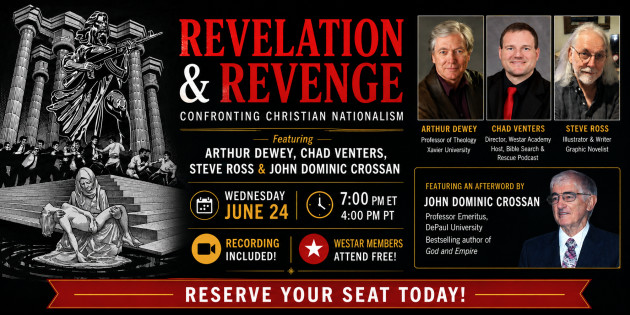
Revelation & Revenge: Confronting Christian Nationalism
A Conversation with Arthur Dewey, Chad Venters, and Steve Ross
How did a first-century vision of resistance become one of the most politically influential—and misunderstood—books in the Christian tradition?
***Recording Included for All Registrants***
******Westar Members Attend Free******
The Book of Revelation continues to shape politics, religion, and public life—but what if many of its most influential interpretations have little to do with what its author intended?
For generations, Revelation has been read as a roadmap to the end of the world, fueling predictions of apocalypse, divine violence, and the triumph of the faithful over their enemies. Today, those interpretations continue to influence public discourse and provide theological support for movements associated with Christian nationalism.
But is that what Revelation was written to do?
Join biblical scholars Arthur Dewey and Chad Venters, along with illustrator Steve Ross, for a discussion of their new book, Revelation & Revenge: Confronting Christian Nationalism.
Combining historical scholarship with striking graphic illustrations, the book returns Revelation to its original Roman imperial setting and explores how its message has been transformed over the centuries.
Featuring an Afterword by John Dominic Crossan, this timely conversation examines how a first-century text became one of the most politically influential—and frequently misunderstood—books in the Christian tradition.
In This Webinar, You'll Explore:
- What Revelation meant to its original audience
- The Roman imperial context behind its vivid imagery
- How Revelation became associated with end-times prediction
- Why interpretations of Revelation matter in contemporary politics
- The relationship between apocalyptic thinking and Christian nationalism
- How historical scholarship can illuminate public conversations today
Whether you are a student of religion, a person of faith, a former evangelical, or simply curious about the role biblical interpretation plays in public life, this webinar offers fresh insight into one of the most influential books ever written.
About the Book
What if the most influential interpretations of Revelation today have almost nothing to do with what its author intended?
With urgency and provocation, Revelation and Revenge: Confronting Christian Nationalism challenges one of the most dangerous political ideologies of our time: militant theology based on the Book of Revelation.
Biblical scholars Chad Venters and Arthur J. Dewey, and acclaimed illustrator Steve Ross, with an Afterword by John Dominic Crossan, provide an incisive, learned, and accessible book aimed at informing the public about the true story of Revelation and its false representation today.
This book dispels fear-based End-Time prophecies that have dominated the American religious and political landscape for decades. The authors pull back the layers of tradition to expose how modern rapture theology is not an ancient biblical truth but a highly profitable nineteenth-century invention. Today, rapture theology actively weaponizes the political climate to escape environmental accountability, deny scientific reality, and rewrite democratic laws under the banner of Christian supremacy.
About the Presenters

Arthur J. Dewey is Professor of Theology at Xavier University and a Westar Scholar. He is the author of numerous books, including Inventing the Passion, The Gospel of Jesus, and The Authentic Letters of Paul.

Chad Venters is Director of Westar Academy and host of the Bible Search & Rescue podcast. His scholarship focuses on the historical Jesus and apocalyptic literature.

Steve Ross is a New York-based illustrator and writer known for his graphic novels Marked and Blinded, as well as his artwork for The Wall Street Journal and The New York Times.
Westar Institute is a 501(c)(3) nonprofit dedicated to educational and scholarly work. Its imprints, Westar Press and Polebridge Press, share this mission and do not operate for profit. All views expressed in this publication belong solely to the authors and do not represent Westar Institute or its affiliates. As publisher, Westar does not endorse the content and maintains no political affiliations or positions.