

ShostaVodka! Piano Trios: Alissa Firsova, Daniel Rowland and Yoanna Prodanova
ShostaVodka! Piano Trios: Alissa Firsova, Daniel Rowland and Yoanna Prodanova
Share this event
Need help?
Part of the Roman River Festival 2025 - See all concerts here.
We start this compelling journey through Russian and post-Soviet musical landscapes with a free shot of vodka (Spring Water Vodka from the Essex Spirits Co.) and a toast to honour the Maestro, Dmitri Shostakovich, the Russian composer whose music and life reflect the turbulent history of 20th-century Soviet Russia. A master of irony and emotional depth, he faced censorship and denunciation under Stalin, in his works often encoding political critique beneath a surface of conformity. Despite the oppression, Shostakovich's music combines biting satire, sorrow, and resilience, capturing both personal and collective struggle. It may be 50 years since he died, but he remains one of the most influential composers of the modern era, blending tradition with innovation in a distinctly Russian voice.
Bracketing this concert are Shostakovich's two Piano Trios; to encounter both on the same programme is extraordinary. Composed more than twenty years apart, they offer a striking portrait of the composer at two very different stages of his life and career. Youthful fire meets mature depth, hope contrasts with tragedy as we move from the precocious brilliance of a composer on the threshold of his career to themes of grief, loss, and resilience. Rarely performed together, they reveal his full emotional landscape—urgency, wit, grief, resilience—offering a profoundly moving journey through his artistic and human spirit.
Young Artist Spotlight: The concert opens with three songs - performed by young soprano, Alexandra Bell-Cobbold - from the Blok Cycle, or 'Seven Romances on Poems by Alexander Blok', which Shostakovich wrote in 1969. Blok's Symbolist poetry resonated with the composers own struggles under Soviet oppression; Shostakovich captures the poems' dark, dramatic qualities, reflecting both Blok's existential despair and his spiritual yearning.
We then move on to Shostakovich’s Piano Trio No. 1 (1923), written when the composer was just 16. Brimming with youthful fervour and lyrical sensitivity, the single-movement work already hints at the wit and melancholy that define his mature style but remains intimate and lyrical—shaped by the post-revolutionary optimism of the Russian Silver Age, before the full weight of Stalinist repression set in. Rachmaninov’s Sonata for Cello and Piano (1901), composed in pre-revolutionary Russia, reflects a lush, late-Romantic aesthetic, a product of a cultural moment where Russian music was asserting itself on the world stage, and individual expression still flourished under the Tsarist regime. Composed in the wake of the composer’s recovery from depression, it presents the cello not as a mere accompanist but as an equal partner in dialogue. Sweeping melodies and intricate pianism intertwine, each movement carrying the listener through tenderness, nobility, and ecstatic release.
After the interval, the concert then shifts to Algarvia by Alissa Firsova herself, composed for Daniel Rowland. Named after Portugal’s Algarve region, it conjures shimmering light and restless motion, with angular lines and delicate textures that challenge and refresh the ear.
The programme concludes with Shostakovich's towering Piano Trio No. 2 (1944). Written during World War II after the death of his close friend Ivan Sollertinsky (1902–1944), a brilliant Russian musicologist and critic, extraordinary polymath - fluent in many languages, deeply knowledgeable in literature, philosophy, and the arts - who served as artistic director of the Leningrad Philharmonic. Written too amidst the Holocaust, its Jewish-themed finale is a powerful, ironic lament, encapsulating the despair and resilience of an artist under totalitarianism. Its final movement, a ghostly danse macabre, leaves a profound impression—a searing testimony to human endurance in the face of suffering.
Together, these works form a narrative of beauty, oppression, resilience, and exile—charting the complex intersections of Russian culture, history, and politics across the 20th century.
***
Alissa Firsova is a British-Russian pianist, composer, and conductor whose work bridges Russian heritage and Western classical traditions. Born in Moscow in 1986, she moved to the UK in 1991 with her parents, composers Elena Firsova and Dmitri Smirnov, after they were blacklisted by the Soviet regime. She began composing at a young age, winning the BBC Proms Young Composer Competition in 2001 at age 15 with her piano piece Les Pavots. She has composed a diverse range of works, including orchestral pieces, chamber music, and choral compositions. Notably, her Stabat Mater, recorded by The Sixteen, was featured in Gramophone’s Top 10 Compositions by Women. She has performed internationally, including debuts at Wigmore Hall and the Proms in 2009, and has collaborated with esteemed artists such as Henning Kraggerud, Tim Hugh, and the Dante Quartet.
Cellist David Cohen is unfortunately unable to be at this concert as originally billed, but we are also very excited about his replacement, the dynamic Yoanna Prodanova. Born in Bulgaria, when she was 14, Yoanna's family emigrated to Canada where she studied at the Conservatoire de musique de Montréal with Denis Brott. Next came the Guildhall School in London and an Advanced Diploma at the Royal Academy of Music, where she won the Bicentenary Scholarship and performed with the RAM Orchestra. She performs internationally with the award-winning Barbican Quartet, and has played with leading UK orchestras. Her debut CD - Janacek, Fauré and Chopin - with the fantastic pianist Mihai Ritivoiu was for Linn Records and she has also recorded the Brahms clarinet trio for Orchid Classics with the outstanding Somi Kim and Joseph Shiner. Yoanna plays a Giovanni Gagliano cello generously loaned by the Canimex Group.
Acclaimed for his versatility, expressive artistry, and commitment to both classical and contemporary repertoires, Daniel Rowland has performed with esteemed orchestras worldwide, such as the Orchestre de Picardie and Princeton Symphony Orchestra. He is a passionate advocate for contemporary composers, premiering works by Isidora Žebeljan and Roxana Panufnik, the founder and artistic director of the Stift International Music Festival in the Netherlands, celebrated for its intimate and adventurous programming, and a professor at the Royal College of Music in London. As a chamber musician, Rowland was the first violinist of the Brodsky Quartet for twelve years, recording extensively, including the complete Shostakovich quartets.
Young soprano, Alexandra Bell-Cobbold, who hails from Colchester, will be performing three songs from the Blok cycle as part of the concert. Alex is studying for a BMus (Voice, Soprano) at the Royal Welsh College of Music and Drama under Prof. Nuccia Focile. She has already won several prizes -including the 2022 Colchester Rotary Festival of Music, Singer of the Year AWARD - and most recently was invited to sing for HRH Duchess of Gloucestershire at the East London School of Music 10th Anniversary celebratory concert.
PROGRAMME
Alex Bell-Cobbold | Shostakovich Seven Romances on Poems by Alexander Blok Op.127: The Ophelia Song; The City Sleeps; We Were Together
Shostakovich Piano Trio No. 1
Rachmaninov Cello and Piano Sonata
Interval
Alissa Firsova Algarvia for violin and piano [written for Daniel Rowland]
Shostakovich Piano Trio No. 2
Duration: approx. 1 hour 45 mins (incl. 20-minute interval)
Tickets £32 (incl. a complimentary shot of vodka)
Alissa Firsova | piano
Daniel Rowland | violin
Yoanna Prodanova | cello
Alexandra Bell-Cobbold | soprano
***
Planning: Doors open from 7.15 for 8pm start.
Parking: It's possible but difficult to park in the side streets near the church. However, there is parking 5-10 minutes walk from the church in the following car parks:
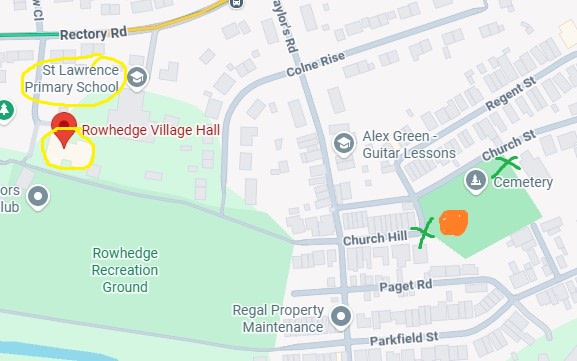
- Outside Rowhedge Village Hall (Rectory Road CO5 7HX) - ringed in yellow.
- In the Primary School carpark (Rectory Road CO5 7HR) - ringed in yellow. They have kindly agreed to keep their gates open for us. Please do double park and use all the space available. At the end of the concert, we will ask our volunteer Dave Rado to use his car parking super powers to help everyone leave again easily.
See map below for both. You can take a shortcut across the park (bring a torch as it can be dark!)
There are two gates into the churchyard. On the map below, you can see that there is a much shorter walk to the church (the orange blob) from the top gate, so please drop off anyone who cannot walk far at this gate.
We will have a volunteer in place by both the top and the bottom gates (marked with green crosses) to the churchyard to direct you to available parking.
***

Roman River Music is always keen to support local products. This evening, we are delighted to have partnered with the Essex Spirits Company and to be enjoying their Spring Water Vodka, made from British wheat and naturally filtered Essex spring water from Elsenham.
Chelmsford’s first operational distillery was established in 2020 by Zane Chiswell-Rivas. Initially launched from his grandmother’s garage, the company has grown into a celebrated local producer of premium spirits. The company emphasizes sustainability, using locally sourced ingredients and eco-friendly packaging, such as refillable bottles, and is committed to supporting local communities and businesses, supplying their handcrafted spirits to bars and restaurants across Essex - look out for their distinctive gold wax seals with the three Essex swords. For more information, to book a tour, a tasting, or even create your own custom blend, visit their website at essexspiritsco.com.
***
The Church of St Lawrence, like St Botolph’s in Colchester, was designed by William Mason of Ipswich and constructed between 1837 and 1838 to serve the growing riverside community, replacing an older church nearby. Inspired by the Chapter House of York Minster, the Gothic Revival church features an unusual octagonal plan and is built from white brick. The grey slate pyramid roof complements its distinctive design. The church replaced an earlier medieval building located approximately half a mile southwest, which had become inadequate for the expanding population. Notably, the interior houses a reredos from 1682, believed to have originated from St Paul's Cathedral, and a monument to Elizabeth Marshall dating back to 1613, both preserved from the previous church.
Mason subsequently emigrated to New Zealand where his influence as the country’s first professionally trained architect was significant; he designed numerous public buildings and played a pivotal role in shaping the architectural landscape of the young colony. His legacy includes the first Government House in Auckland and various other civic structures, marking him as a key figure in the nation's history.
Location
St Lawrence, Rowhedge, CO5 7EB