
IoT Applications | Module 12: Software Development
IoT Applications | Module 12: Software Development
Share this event
IoT Applications | Module 12: Software Development
We offer 50% discount to students, please complete this form to avail discount.
Programme Structure
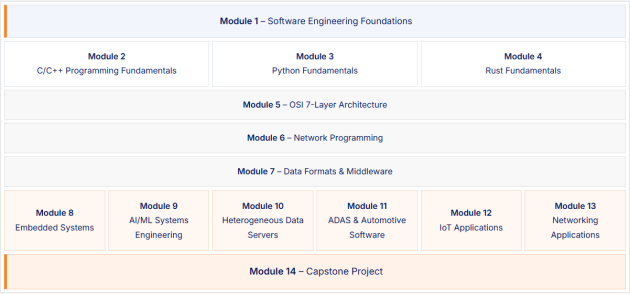
The programme consists of 14 modules delivered across 18 live sessions:
- Module 1: Software Engineering Foundations | 28 Oct 2026 9:00 AM - 11:00 AM BST
- Module 2: C/C++ Programming Fundamentals | 29 and 30 Oct 2026 10:00 AM - 2:00 PM BST
- Module 3: Python Fundamentals | 2 and 3 Nov 2026 10:00 AM - 2:00 PM BST
- Module 4: Rust Fundamentals | 4-5 Nov 2026 10:00 AM - 2:00 PM BST
- Module 5: OSI 7-Layer Architecture | 6 Nov 2026 10:00 AM - 2:00 PM BST
- Module 6: Network Programming | 9 Nov 2026 1:00 PM - 5:00 PM BST
- Module 7: Data Formats and Middleware | 10 Nov 2026 1:00 PM - 5:00 PM BST
- Module 8: Embedded Systems | 12 Nov 2026 1:00 PM - 5:00 PM BST
- Module 9: AI/ML Systems Engineering | 16 Nov 2026 10:00 AM - 2:00 PM BST
- Module 10: Heterogeneous Data Servers | 19 Nov 2026 10:00 AM - 2:00 PM BST
- Module 11: ADAS and Automotive Software | 24 Nov 2026 10:00 AM - 2:00 PM BST
- Module 12: IoT Applications | 26 Nov 2026 10:00 AM - 2:00 PM BST
- Module 13: Networking Application | 30 Nov 2026 10:00 AM - 2:00 PM BST
- Module 14: Capstone Project | 2-3rd Dec 2026 10:00 AM to 2:00 PM BST
Register for the full 14-module training here.
Discover how modern Internet of Things (IoT) solutions connect embedded devices, edge gateways, cloud platforms, and real-time data services. This practical module explores the complete IoT ecosystem, from device firmware and lightweight communication protocols to cloud integration, telemetry pipelines, fleet management, and secure over-the-air updates.
Through practical demonstrations and a comprehensive end-to-end project, you'll learn how scalable IoT platforms are designed, deployed, and managed using industry-standard tools and technologies.
What You Will Learn
By the end of this module, you will:
Understand end-to-end IoT system architecture
Explore lightweight communication protocols including MQTT and CoAP
Build secure IoT device connectivity
Develop edge gateway and cloud integration workflows
Implement telemetry pipelines and time-series data storage
Learn device provisioning, fleet management, and OTA update strategies
Apply security best practices across connected IoT systems
Who Should Attend
Embedded Software Engineers
IoT Developers
Firmware Engineers
Backend & Cloud Developers
Systems Engineers
Electronics Engineers
Edge Computing Developers
Topics Covered
Session 1
IoT Architecture
Device, edge, gateway, cloud, and application tiers
Constrained devices and edge computing
Connectivity & Protocols
MQTT
MQTT-SN
CoAP
WiFi
BLE
Zigbee
LoRaWAN
NB-IoT
LTE-M
Edge & Cloud
Edge gateways
Protocol translation
Offline buffering
Device registry
Device twins and shadows
Rules engines
Telemetry ingestion
Device Management
Provisioning
Identity management
Fleet management
Over-the-air (OTA) updates
IoT Security
Device certificates
TLS / DTLS
Secure boot
Least-privilege access
Programming Languages
C/C++
Embedded Rust
Python
Open-Source Tools
Eclipse Mosquitto
Eclipse Paho
Node-RED
InfluxDB or TimescaleDB
Grafana
Module Project
Build a complete end-to-end IoT telemetry platform featuring:
Sensor node (MQTT publisher)
Edge gateway
Cloud ingestion
Time-series database
Live dashboard
Device provisioning
OTA update workflow
Key Benefits
✔ Learn how modern IoT platforms are architected
✔ Build secure device-to-cloud communication pipelines
✔ Explore edge computing and cloud integration
✔ Gain practical experience with industry-standard open-source tools
✔ Complete a real-world IoT telemetry project