

What prior Bending Spoons acquisitions tell us about the likely impact for Eventbrite users
An examination of publicly available evidence and historical patterns of Bending Spoons acquisitions to summarise impact for Eventbrite users.

It's no secret that here at Ticket Tailor we position ourselves as the leading alternative to Eventbrite. A significant number of Ticket Tailor users are ex-Eventbrite clients who found us after looking for an alternative. That's one of the reasons we keep a close eye on any updates.
As we’ll come on to highlight, we’re writing this article to inform users of Eventbrite about the potential changes they could experience using the platform post its acquisition by Bending Spoons.
Here’s what we’ll be covering:
- Likely price changes
- Likely impact on customer support
- What may happen to user and ticket buyer data
- What staff layoffs could mean for users
- Our recommendations for event organisers currently using eventbrite
Disclaimer: This article is based on publicly available information and historical patterns observed across previous acquisitions; outcomes for Eventbrite may differ.
Introduction
The news that Bending Spoons were approaching Eventbrite started circulating in late 2025, a deal that came to fruition on 10th of March 2026 for a transaction valued at $500m with a $4.50 per share consideration.
This follows a prolonged decline in Eventbrite’s market value and a period of inconsistent financial performance. An 80-85% share price decline shows the loss in market confidence over multiple years placing it in prime acquisition territory.
Like many in the world of events, the 2020 Covid pandemic threw many in the industry into financial uncertainty. Despite struggling to get to pre-2020 levels, Eventbrite did bounce back quite strongly. The subsequent share price decline came from an inability to reach consistent levels of profitability and the growth seen prior to the pandemic.
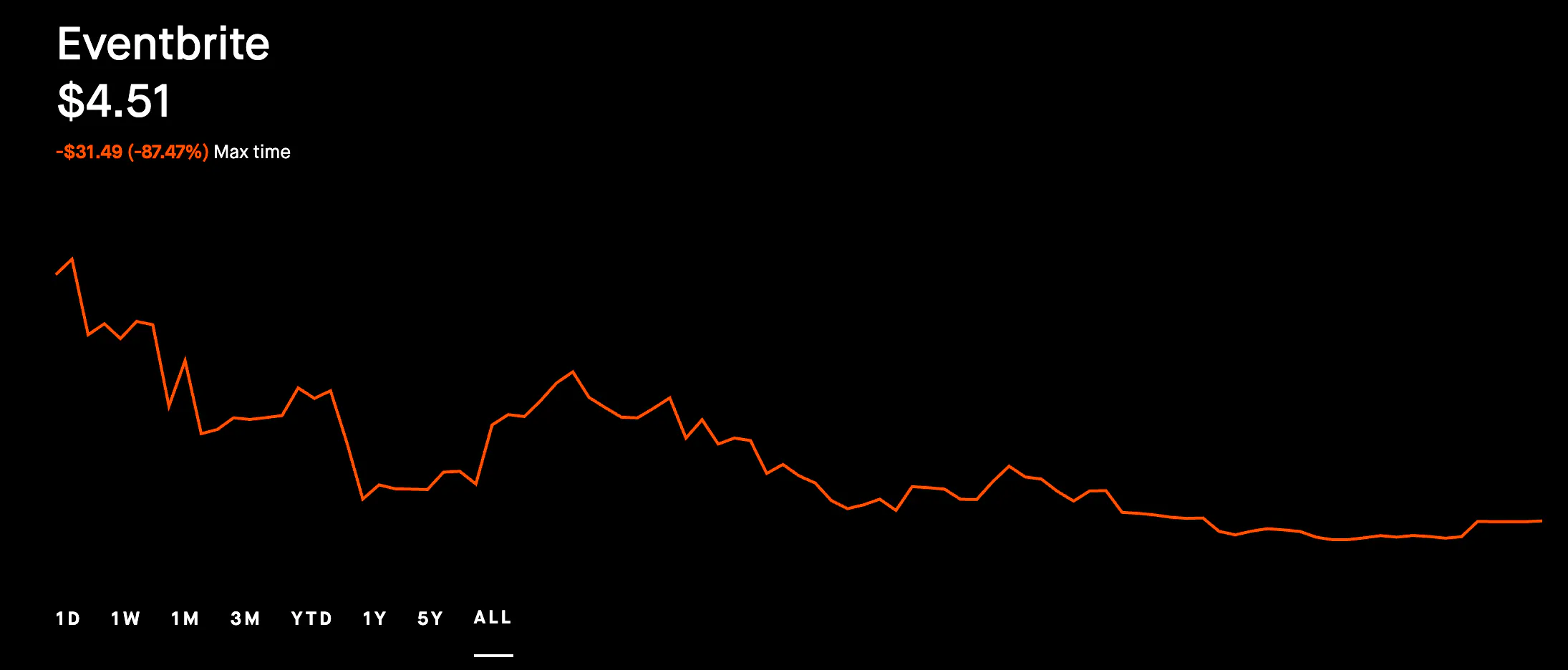
As documented in their own end of year reports, the company has repeated net losses year on year post its IPO:
Another key financial metric is EPS (Earnings Per Share) which at the time of acquisition was -12. This metric is an indicator of profitability. In simple terms this metric looks at company revenue divided by the number of shares. A negative number means the company is losing money.

For all the financial jargon, one thing is clear, Bending Spoons is no first timer. They have a track record of identifying companies in a similar position and acquiring them. It’s happened with Vimeo, WeTransfer, Komoot, Meetup and AOL to name a few.
Our aim with this article is to examine publicly available evidence and historical patterns of Bending Spoons acquisitions to summarise what this likely means for event organisers currently selling tickets on Eventbrite.
If you’re using Eventbrite and reading this article we’ll also include some links to further articles we’ve written about Eventbrite alternatives that you may want to explore.
In the following sections we’ll highlight:
- The Bending Spoons operating model and what this likely means for how Eventbrite will be run.
- Patterns to workforces after acquisition and the knock-on effect on customer service.
- Patterns in pricing changes and/or pricing models and what this means for how much users pay
- Customer satisfaction, reviews and trust after acquisitions.
- Eventbrite alternatives you may want to consider.
How does Bending Spoons operate and what does this mean for businesses they take over?
What we know
The Bending Spoons home page clearly states that they position themselves as a long term operator to improve products “not to sell on, but to own and operate for the long term”, and that transformations are “often deep” to speed innovation and strengthen business performance.
This is positive for Eventbrite users – if incoming change is taken with a long term view then it helps current users of the platform understand that this takeover isn’t with the objective of a quick turnaround for profitable gain only.
Can we validate this claim?
Looking back historically; Bending Spoons was founded in 2013 with $40,000 seed capital from an unsuccessful venture-funded product called Evertale. They started out as a consumer mobile app developer focused on utility apps (photo editing, video, fitness) and global mass market audiences. Early products include Splice, a video editor later sold to GoPro.
It wasn’t until around 2018 that Bending Spoons started to seriously scale. Using the capital they had built from apps like 30 Day Fitness, they started acquiring applications in the same mass market consumer space. Apps like Remini, which they acquired in 2021, became their flagship revenue engine. Other notable acquisitions around this time include video editing software developer FiLMiC Inc.
All of these still remain under the control of Bending Spoons.
Our hot take: Bending Spoons acquisitions follow a predictable playbook
If phase one was in-house development of mass market mobile apps, and phase 2 was the acquisition of apps in a similar space – then phase 3 is where Bending Spoons is now, having ventured into larger internet platforms like Vimeo, We Transfer, AOL and now Eventbrite. All of these acquisitions have come post-2023, making it harder to validate their long term claims in this instance.
What we see is Bending Spoons’ ability to acquire billion-dollar platforms is rooted in a decade spent building highly profitable consumer apps, where they refined a repeatable playbook for monetisation, pricing optimisation, and cost efficiency. As we’ll come to evaluate further, the patterns in this playbook are consistent across multiple acquired platforms and our prediction is that we’ll see the same unfold in the case of Eventbrite.
So how exactly will this likely translate into the world of Eventbrite? We’ve looked across the likely areas that Bending Spoons will influence and here’s what we can see…
Workforce consolidation and operational centralisation is a recurring theme
What we know
Across multiple acquisitions, Bending Spoons publicly confirmed moves that reduce headcount and shift operations to Europe (i.e. closer to Bending Spoons’ centre of gravity).
Evernote: Evernote’s official blog states that most operations would transition to Europe and that this required layoffs for most Chile and US-based employees.
Meetup: Bending Spoons’ CEO wrote that moving operations to Europe meant “significantly reducing the size of the US-based team,” explicitly describing layoffs as part of integration.
Vimeo: The Verge reported Vimeo underwent significant layoffs affecting a “large portion” of staff months after acquisition.
FiLMiC: TechCrunch and other reporting describe FiLMiC staff being laid off and note Bending Spoons’ history of overhauling acquisitions.
At the time of writing this article (April 2026), the same has come true in the case of Eventbrite. With large layoffs in their American and Indian teams.
Our hot take: In the world of events, layoffs may lead to changes in how users experience customer support
Layoffs matter more in the world of ticketing and events. At Ticket Tailor we see clear seasonal peaks in busier event periods. Ticketing is time-critical and linked to event day operations which mean that demand on support often has peaks and can at times be unpredictable. With a decline in headcount, customer support may be impacted.
As we come on to highlight later in the article, user reviews of some acquired platforms frequently mention slower or less accessible support, although this is not a direct measure of operational performance
That being said, recent advancements in the world of AI may help mitigate this impact through either faster product development or smarter, non-human customer support. However in our experience, larger events rely more on human support to make them run smoothly and the layoffs may be felt most by these events and those with more complex needs.
What happened to prices and pricing models after past Bending Spoons acquisitions and what this could mean for Eventbrite Organisers
What we know
Price and subscription tiers are increased shortly following acquisition dates.
The most consistent, well-evidenced outcome across Bending Spoons acquisitions is not one specific price change, but a pattern of increased monetisation: higher effective prices, re-bundling, tighter definitions of free, and subscription expansion. Often these price changes are justified as funding foundational work and speeding up innovation.
We’ve taken a look back at previous acquisitions and examined prices changes post-acquisition:
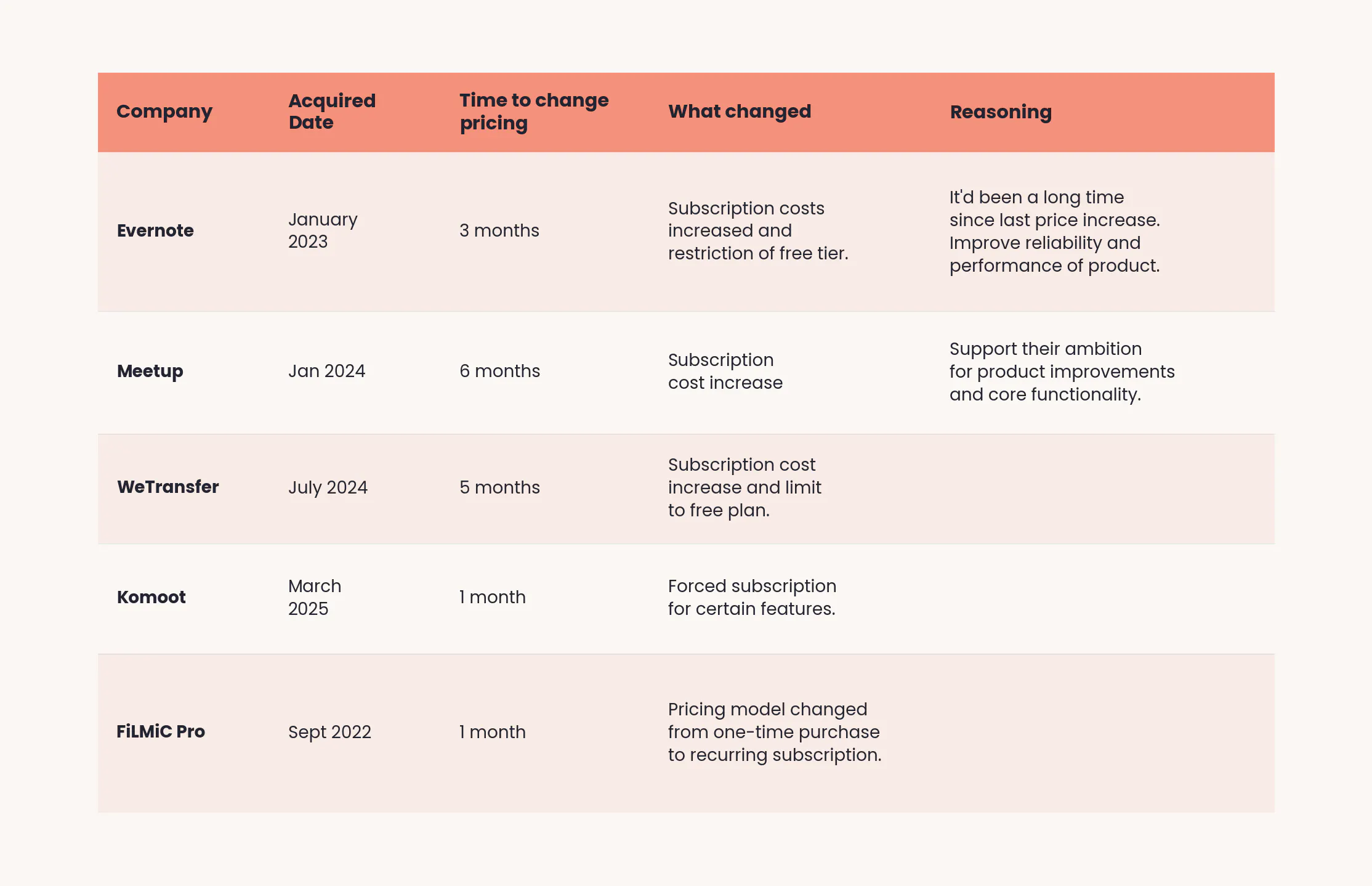
Supporting evidence:
There is a clear correlation between product roadmap and price increases
Previous Bending Spoons acquisitions show a clear vision to improve the product that is fuelled by price model changes and price increases. Eventbrite have recently released a statement citing their ambition to increase the rate of product development, laying out a short term roadmap. If previous acquisitions and patterns are anything to go by, then event organisers on the platform may see price increases.
Perhaps most significantly is a report led by App figures that investigated revenue change and download/usage change of companies acquired by Bending Spoons. The report shows a clear pattern: revenue up, downloads/usage down. A formula only made possible by price increases.
What the Meetup acquisition tells us
Of all of Bending Spoons’ acquisitions, Meetup is worth a closer look in relation to Eventbrite. The two platforms share a similar core proposition: matching people to events and communities (discovery) and equipping organisers to communicate and manage attendance.
Shortly after the Meetup acquisition, their product lead announced pricing changes explicitly framed to enable significant investing starting with a complete overhaul of backend architecture followed by prioritising fixes for organiser workflows and finally AI driven recommendations.
In short, price raises funded a platform rebuild and improvements.
The General Manager that runs Meetup and who has been brought in to run Eventbrite has just announced where they plan on focusing their product development since the Bending Spoons acquisition, and like other takeovers it mentions almost like-for-like focuses:
Platform reliability
“We’re investing heavily in Eventbrite’s reliability to ensure it’s faster during key workflows and more stable during the most crucial moments on event day.”
Creator tools
“This means a more intuitive and efficient platform, from check-in and reporting to refunds and payouts. We’re also exploring the capabilities that matter most to creators running events at scale, such as direct SMS communication, reserved seating configurations, bulk attendee transfers, and more powerful waitlist management.”
Event reach and discovery
“Beyond upgrading the reach and discovery tools already in place, we’ll be working on the improvements that make that possible: marketing tools to promote your events on and off Eventbrite, attribution and conversion reporting, and better SEO for event listings so more people find you organically.”
A clear pattern of historical price increases a few months after acquisition dates, together with the correlation between product changes and price increases, suggests Eventbrite users may see pricing or packaging changes in 2026. Given the acquisition was announced in March 2026, historical timelines suggest any pricing or packaging changes, if they happen, could emerge later in 2026.
Our hot take: Organisers could see pricing changes in the coming months
The historic timelines following acquisitions, clear relationship between the announcement of product improvements and the evidence we can take from Meetup – a platform that shares similar characteristics and leadership – suggests that pricing changes are a possibility in the next few months for users hosting events on Eventbrite. We’ve already seen those product announcements happen, significant layoffs made and our expectation is that price changes could follow.
It’s hard to predict exactly what this will look like, as – unlike some of the more straightforward consumer apps under the ownership of Bending Spoons – Eventbrite has more pricing levers to pull. Our advice is to keep an eye out for changes in platform fees, the fixed fee per ticket sales, and certain features being put behind a paywall (or that paywall fee increasing).
The big question though will be whether free events remain fee free.
Some industry commentary has suggested that free tiers may come under pressure, particularly given this accounts for c25-30% of all tickets issued on Eventbrite and they have limited contribution to revenue. While there’s no confirmation this will happen it could be a tempting focus for Bending Spoons and it’s an area organisers may want to monitor.
How do customers of Bending Spoons-acquired companies review their experience post takeover?
What we know
Analysis of Trustpilot reviews from Bending Spoons-acquired companies
For four of Bending Spoons’ most recent takeovers we’ve collated Trustpilot reviews pre- and post-takeover. This piece of analysis looks at a total of 1095 reviews across 4 acquired companies collected from as early as 2020 to the present data at the time of writing (April 2026). Categorising 1- and 2-star reviews as negative, we’ve looked at the proportion of negative reviews pre-acquisition and post-acquisition.
Across the platforms examined, the proportion of negative reviews increased post-acquisition. While this does not establish causation, it highlights a shift in user sentiment worth noting.
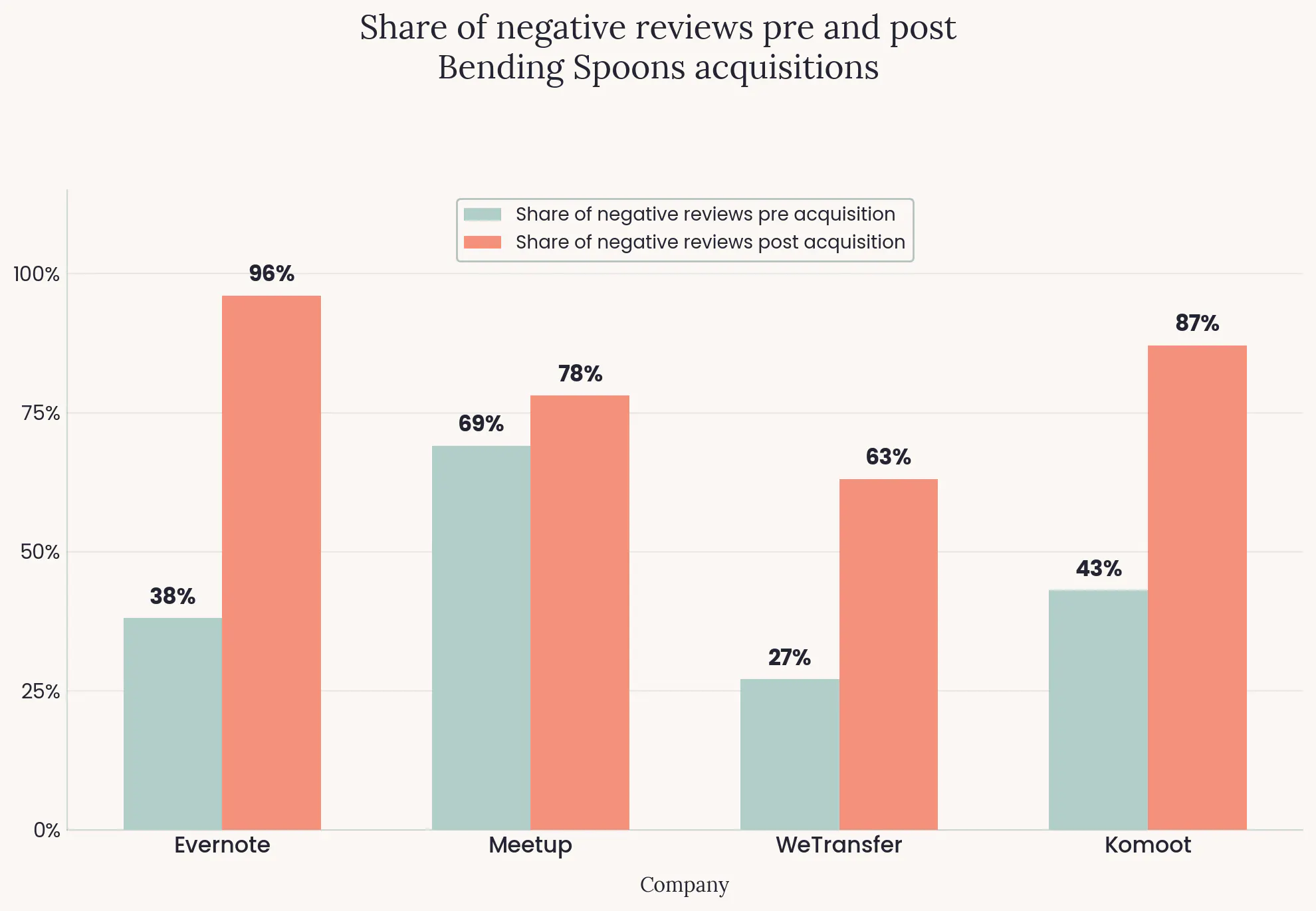
To help, we’ve also collected a sample of both positive and negative reviews published after acquisition dates, to help give you an idea of what customers are saying:
Evernote
Evernote is rated 1.6* on trustpilot at the time of writing
Negative reviews post acquisition
- "Was one of the original users when the app was free and good. They've now held 20 years of my free notes hostage for $26 a month."
- "Aggressive paywalls and unskippable ads - I feel that my own data is being held hostage."
- "After using Evernote for what must be decades, I now must look for an alternative."
- “This used to be the go-to software, but now, it's overcomplicated and too busy. The price has gone up, and the quality and service have gone down.”
- “I've used Evernote for probably over 15 years. Once they were bought out by Bending Spoons their subscription price has skyrocketed.”
- “Predatory pricing escalation and a hostile deletion funnel under Bending Spoons
Long-time Evernote user. Here is my actual billing history straight from the account:
April 2023: $69.99
April 2024: $129.99
April 2025: $129.99
April 2026: $249.99
That is a 257% increase in three years for the same product. No new features justified it. The April 2026 charge hit my card on auto-renewal.”
Positive reviews post acquisition
- “I've been a user for 15+ years, and EN has seen its ups and downs, for sure. Bending Spoons has improved this app in so many ways - - they are deeply responsive to the needs of their users and they are sincerely making changes that make it easier and more essential to daily use.”
- “I have been using Evernote since 2008 and it is still my go-to app for storing and retrieving information.”
- “Evernote today is a lot more faster than before with a modern UI. It doesnt attempt to be a database kind of PKM like Notion, but it still offers a powerful notetaking and organizing system that continues to be relevant today.”
Meetup
Meetup is rated 2.3 stars with 694 reviews on Trustpilot.
Negative reviews post acquisition
- “Customer service is non existent. It is extremely expensive and complicated to run.”
- “Meetup was a great site for about 10 years and then at some point they got greedy, trying to limit features formerly free to behind a paywall, not to mention making it hardly impossible for free members to use the site without constantly pestering them to sign up for a paid membership.”
- “Whomever is responsible for the change in the business model of Meetup should be fired. There were so many other options to choose from than putting up a paywall at exorbitant monthly costs just to RSVP to an event.”
- “Look you had a price increase for a wonky app, then you were sold off and now the app doesn't even work. I have error messages trying to renew things and or your app clashes. and now I will lose my group event though I have been trying to get help and or I get is this silly stupid AI response.”
- “Whilst I enjoyed using their app for Toastmasters meetings... being charged £150 for a dormant page I shut down (on the weasly grounds that I'd not cancelled the subscription) is unacceptable.
Tweet them? No reply.
Contact form them? Fobbed off by a bot.
Any other method? Mythical.
To be that uncontactable shows a disdain and contempt for users, hence this review... that I wish I never had to write.”
Positive reviews post acquisition
- “I have found multiple ways to have fun and meet new people in safe environments on meetup.com! I went on a social hike and to multiple different board game events in the last week and a half.”
- “I've been on the platform since 2005. It has helped me to find groups across nine states through the years, even when just visiting an area for a short period. Meetup.com has been a tremendous partner in supporting my personal growth for over two decades
- “A safe space to express yourself without being judged”
Wetransfer
Wetransfer is rated 2.5 stars on Trustpilot with 780 total reviews
Negative reviews post acquisition
- “WeTransfer became big time scammers. They almost doubled the price of their subscription from 2025 to 2026, alleged that they emailed subscribers (which they did not), and they don't let you downgrade to a monthly account. So, if like me, you've been using their services for years and have tons of uploads, your only choice now is to either pay double what they were charging last year, or lose everything you ever uploaded to their platform.”
- “Wetransfer was great years ago. It began going downhill at some point. Sending and downloading got more and more options and annoying selections and lost the straight forwardness. All kinds on unnecessary bloat.”
- “Apart from just upping me fees and almost doubling it in a year while also making our content able to be used in AI content and overall a minimal service I can’t justify the expense of over 250 pounds a year, so looking for alternatives as this service is not worth this much money."
Positive reviews post acquisition
- “Very simple to use and for people to receive and download. Totally reliable and always works 100% of the time I use it. Cost effective with different options to suit requirements. Really pleased with the service.”
- “I've been using WeTransfer for many years and it's never let me down. It works perfectly and this type of service is a great help. Thank you.”
- ‘Very satisfied with WeTransfer. Super easy to use. I have not experienced any issues with subscription pricing.”
Our hot take: customers cite more negative experiences after a Bending Spoons takeover
What can we take from reviews?
From analysing Trustpilot reviews we observed a pattern of increased negative sentiment post-acquisition around pricing, changes in fees and customer service. This doesn’t mean it’ll necessarily translate to Eventbrite, but should be something existing users are aware of.
Trust and policy controversies
What we’ve observed
How data may be handled within Bending Spoons’ infrastructure
One area we’ve picked up on in our research is that of data privacy and policy. Eventbrite organisers are already required to surrender ticket buyer information with the platform. If Eventbrite’s terms are updated to reflect Bending Spoons as the operating party, that may indicate a shift in how data governance and group-level infrastructure are described.
Bending Spoons operates a shared infrastructure (The ‘Spoon Engine’) used across its products, which includes services such as authentication, analytics, and AI tooling. While it’s not publicly confirmed how Eventbrite data will be handled, similar platforms such as Meetup updated their policies post-acquisition to allow data sharing within the wider corporate group.
Like Meetup, policies and T&Cs will potentially fall under a broader Bending Spoons agreement
It’s worth a closer look at Meetup here. Like Eventbrite, it sits between two kinds of users – organisers and attendees – and both platforms hold rich behavioural data about in-person gatherings: who attends what kinds of events, how often, in which locations, with what social connections. The data profile of a Meetup member or Eventbrite attendee is arguably more commercially valuable than, say, an Evernote user's notes, because it maps real-world social behaviour and interests at scale.
After Meetup’s acquisition, their terms of agreement changed to include Bending Spoons and its affiliates and subsidiaries under any “we”, “us”, “our” and “Meetup” terms. This change reflects the acquisition and signifies that the platform operates as part of a broader corporate group.
The terms of agreement changing for Meetup mean that their wider policies need to be considered in the light of Bending Spoons operating as part of the broader corporate group.
The following line is written in the Meetup Privacy Policy:
“We may also share information about you with current or future corporate parents, subsidiaries, or affiliates”
Whether it's Meetup or now Eventbrite, we can't say for certain that your data is being shared across the broader Bending Spoons platform. What we can say is that their terms of agreement – much like the “Spoons Engine” – make it possible.
At the time of writing there is no mention of Bending Spoons in any T&Cs but our recommendation is to keep an eye out for updates and do the rare thing of actually reading the small print.
Our hot take: organisers should watch closely for changes to Eventbrite’s terms and privacy disclosures.
We cannot say from public sources exactly how Eventbrite organiser or attendee data will be handled after the acquisition. What we can say is that Bending Spoons operates shared infrastructure across products, and that other acquired platforms such as Meetup updated their policies to allow information sharing within the wider corporate group. Organisers should therefore monitor future updates to Eventbrite’s terms, privacy notices, and product architecture and do the rare thing of reading the T&Cs and small print.
Customer support outcomes and what Eventbrite users can reasonably infer
What we know
Bending Spoons and acquired companies repeatedly describe integration and restructuring that reduces legacy teams (Evernote and Meetup explicitly; WeTransfer and Vimeo widely reported).
From a systems perspective, large headcount reductions typically force one (or several) customer support changes:
- greater reliance on self-serve documentation,
- narrower support scope,
- more automation,
- reprioritisation toward higher-paying segments.
Direct measurement of response times is rarely public, but user-generated reviews do frequently complain about “non-existent” or delayed support in some of these products (as we highlighted in our reviews analysis above).
At the same time, Eventbrite’s own internal communications state that Bending Spoons aims to strengthen customer support, and Eventbrite’s acquisition FAQ emphasised accelerating innovation and strengthening tools/resources.
Our hot take: Eventbrite users may see more reliance on AI and automation in customer service
We therefore can’t accurately predict what will happen to customer support and service for Eventbrite users but we can infer:
- The risk to quality of customer support is highest during the integration window, when organisations centralise, leaders turn over, and internal tooling/processes change. This is strongly consistent with how Evernote and Meetup described their transitions to European locations (and how press described the impact of workforce reductions at WeTransfer/Vimeo). With staff layoffs already announced, we’ll soon understand this impact on customer support in real terms.
- The increased negative sentiment following takeovers and the more frequent mention of poor or non-existent customer service in reviews of Bending Spoons-owned companies could be a pattern that Eventbrite users will experience too.
- From wider industry trends and advancements in AI, it is possible Eventbrite users will see increased reliance on AI and automation in their interactions with customer service.
Summary
The best-supported lesson from Bending Spoons’ recent acquisition history is that pricing and packaging changes are the lever that finance faster product change, often alongside operational consolidation. For Eventbrite, Bending Spoons has already named the first likely product arcs – messaging, AI-assisted creation, better search, and secondary ticketing – so the key remaining uncertainty for organisers is whether those capabilities arrive as “included improvements,” or as part of a new segmentation of paid tiers and fee structures.
Our recommendations for event organisers currently using Eventbrite.
We understand that Eventbrite is central to the operational process of many event organisers and in some instances a key method of getting their event discovered and generating revenue.
If you’ve read this article and feel a level of uncertainty or worry about your event following the Bending Spoons acquisition, then we recommend the following.
Use two platforms simultaneously
Our Head of Sales, Donald Bain states:
“We're noticing a lot of Eventbrite users dual-platform as a way to hedge risk whilst evaluating some alternatives.”
You don’t have to immediately up sticks and transition your entire event or portfolio of events. Many people who have switched from Eventbrite to Ticket Tailor have continued to run events on Eventbrite for a period of time whilst they assess the difference in platform capabilities and any impact on ticket sales.
Review options early rather than waiting for changes to land
The ticketing industry has many options for event organisers. Depending on your requirements you may value certain features more than others or heavily rely on listings within marketplaces for sales. Different ticketing platforms specialise in different things.
We’ve written an article listing 6 different Eventbrite alternatives outlining the specialities and things worth considering for each alternative when making your decision.
If you’re interested in how Ticket Tailor compares to Eventbrite directly, you can check out more detail on our Eventbrite comparison page.
We’ll keep this article updated as more evolves.