Community vs headliners: what should independent festival organisers focus on?
Green Man has sold out two years running before announcing a single act. Here’s what that tells us about where independent festivals should be spending their attention.

Green Man has sold out two years running before announcing a single act. Here’s what that tells us about where independent festivals should be spending their attention.
Every festival organiser has a version of the same argument, usually in a budget meeting in October.
One side of it says the lineup sells the tickets, so the lineup is where the money goes. The other side says the audience comes for the whole thing, so spend it on the site, the bars, the programming, the experience. Both sides are partly right, which is why the argument never resolves.
It’s worth being clear about what the real question is. Almost no festival can choose to have no lineup, and almost none can choose to ignore the experience. The decision organisers actually face is narrower: where does the next available pound go, and where does the next available hour of your attention go?
On that question, the evidence points pretty clearly in one direction.
Two years, two sell-outs, no lineup
Green Man is a 25,000-capacity independent festival in the Bannau Brycheiniog national park in Wales. It’s one of the largest genuinely independent festivals left in the UK.
In September 2024, tickets for Green Man 2025 sold out in an hour, 11 months before the gates opened and before a single artist had been announced. The 2025 lineup, when it eventually arrived the following spring, included Wet Leg, Underworld, Kneecap, Beth Gibbons and TV On The Radio. Nobody who bought a ticket knew that at the time.
Then they did it again. Tickets for Green Man 2026 went on sale at 10am on Saturday 27 September 2025 and sold out in just over an hour, again roughly 11 months ahead, again without a single artist announced. It was the festival’s fourth consecutive sell-out. Owner and managing director Fiona Stewart’s response was simply: "Diolch yn fawr [thank you very much] to the loveliest audience in the universe."
Two on-sales in a row, a full year in advance, with nothing to announce. Whatever those buyers were responding to, it wasn’t a bill.
They were buying something else entirely. Green Man runs 16 areas across the site, taking in comedy, science, live interviews, cinema, circus and wellness alongside the music, plus a Welsh beer and cider festival, a free children’s programme for under-11s and a dedicated space for 12 to 17 year olds. That’s the product. The lineup is one part of it.
The same pattern shows up at small festivals too
Green Man is at the confident end of the scale, but the behaviour it reflects is common across independent festivals, and it looks very different from how the majors sell.
John Rostron is chief executive of the Association of Independent Festivals (AIF), which he told us has around 170 UK festivals in membership. We interviewed him for our series on the sector, and this was one of the clearest patterns he described.
"With the larger festivals, some people are waiting for the lineups and they go, do I go or do I not go? With the smaller events, two things that you see. They sell more tickets on early birds than anywhere else. And early bird is just like a date in a field somewhere next year. And then also when you ask people about why they want to go, they go, you just got to go. They’re not talking about the lineup."
That phrase does a lot of work. "You just got to go" isn’t a description of a music programme. It’s a description of a habit, or a friendship group, or a weekend people have already decided is part of their year.
We see the same thing across the festivals we work with. Folking in the Strawberries is a pop-up folk festival at Stonepitts Farm in Kent, the oldest strawberry farm in the UK. It runs weekly through June and July, welcoming 1,000 people to each of its eight dates, and it sells all 8,000 of those tickets in an hour! Promoter Dan Clews discovered Ticket Tailor during Covid, when it became clear the festival needed proper ticketing for the first time. He’s stuck with us since, and not just for how easily Ticket Tailor embeds into his website, but for how the platform holds up under pressure: each year, all 8,000 tickets sell out in under an hour without the site so much as blinking. The waitlist feature has turned out to be just as useful. It means Folking in the Strawberries is always at capacity, and it gives Dan a live read on demand as he decides how big to grow the festival next.
Nobody is queuing for a headliner. They’re buying an evening of live folk music in a strawberry field in the North Downs, from a festival they already trust. Watch Dan tell the story himself.
Why the corporate model can’t easily copy this
Community-led demand is one of the few advantages independents hold outright.
AIF’s Festival Forecast 2025 maps the UK landscape and found that Live Nation’s UK festival portfolio has a combined ticketed capacity of around 880,000, against 350,000 for Superstruct and 230,000 for AEG. Live Nation owns all but one of the four festivals AIF classifies as "major". That scale buys enormous advantages in supplier negotiation, production and booking power.
What it doesn’t buy is the thing Rostron pointed to when he told us how one of his own members ended up starting a festival in the first place. As a young person, they went to a large corporate festival, and then to a small independent one.
"They went to see the big headliners. There was big steel shield, there was nothing else. And they also went to this little independent festival and they were like, whoa, there was all of these mini venues in this creative world and they absolutely lost themselves. And this individual was like, that’s what I want to do."
He’s careful to say he’s generalising, and that people go to large festivals for good reasons. But his real point is that the two models are built to do different things.
"Independent festivals, sometimes the company behind them is full profit, but they’re built not for profit. They’re built with love first. They’re not built on a spreadsheet. There isn’t an objective at the end which is, we are trying to make money and we need to make money. They’re built to deliver a really solid, brilliant event and they just want to be able to wash their face and do it again next year."
If your competitive position rests on outbidding Live Nation for talent, you’ll lose. If it rests on being a place people feel a sense of ownership over, you’re competing on ground where scale doesn’t help them much.
What "focus on community" actually involves
The phrase gets used loosely, so it’s worth being concrete. Based on Rostron’s observations and what we see across the festivals we work with, here’s what it looks like in practice.
- Sell before you announce, and mean it. If a good chunk of your audience will buy on trust, give them the chance. An early tier priced for the people who don’t need convincing brings cash forward into the months when your suppliers want deposits, and it tells you something useful about how strong your base actually is. If nobody buys before the announcement, that’s information too.
- Consider the whole experience, from how your guests arrive onwards. Rostron’s favourite example is a festival that sits a couple of miles from a motorway junction and deliberately routes arrivals four or five miles further, through the hills, "to set you up. You’re like, whoa, I’ve arrived." It costs nothing. It changes the whole weekend.
- Make it easy to say yes. Payment plans came up unprompted as one of the changes he thinks has mattered most over the past few years. "It’s like, why didn’t we have that before? It’s such an obvious thing. That’s been really brilliant." Spreading a £200 weekend ticket over several months isn’t a discount and it doesn’t cost you revenue. It removes the single biggest barrier for a chunk of your audience. And yes, Ticket Tailor offers payment plans!
- Book locally and confidently. "Sometimes the best quality act or DJ is someone that you know locally. And actually the audience, they’re there. If they’re having a good time, they will love it. If you love it, they will love it."
- Be honest with your audience about your costs. Some of the festivals that have handled the past few years best have done it by explaining themselves. Maid of Stone, a 5,000-capacity AIF member in Maidstone, has frozen its weekend ticket at £150 since 2024, and festival booker Chris Wright said publicly that the team are "doing everything we can to ensure the increase in our costs are not passed on to our loyal supporters." That’s a message to the community as much as a pricing decision. Knockengorroch in Galloway went further and asked its audience directly, raising £18,914 to cover rising costs rather than putting the gate price up. What they did next is the more instructive part. Rather than treating it as a one-off rescue, they turned the response into a year-round supporters scheme, where people who back the festival get access to pre-sale early bird tickets before general release, including those who can’t make it that year. They also run payment plans. Both are ways of turning goodwill into steady early revenue.
- Sweat the unglamorous parts. This is the one organisers skip. Rostron’s list of what makes up the experience is deliberately mundane: "the way that they buy a ticket, the way that they’re communicated with, the way they arrive on site, where the toilets are, what the bar’s like. The music’s just a part of it."
The honest counter-argument
We should be careful not to overstate this, because the version of this article that says lineups don’t matter would be wrong.
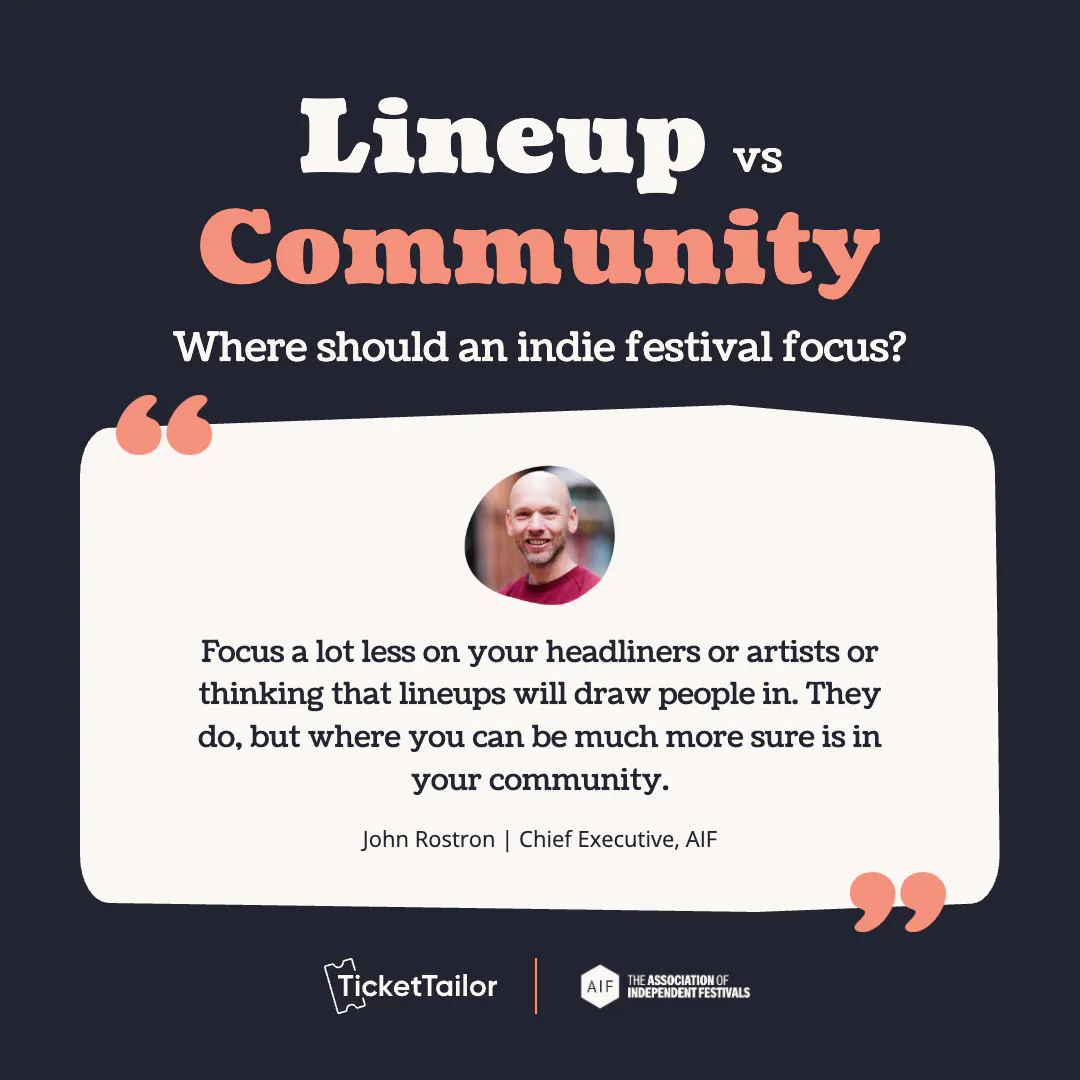
Rostron doesn’t say that. His actual words were: "Focusing a lot less on your headliners or artists or thinking that lineups will draw people in. They do, but where you can be much more sure is in your community." The "they do" is important.
- Community is where you start. Scale is what takes time. It would be wrong to read this as advice that only applies once you’re established. Almost every independent festival begins as a community, because that’s the only thing a new festival has. Rostron’s description of the typical origin story is that it’s "somebody’s party that kind of gets out of hand, and let’s do it again", or a group of people who notice that nothing in their genre happens where they live and decide to fix it. Folking in the Strawberries began in 2008 with Dan Clews playing music to the pickers during a late-night strawberry-picking session at his parents’ farm. That’s the community-first model on day one, not a strategy adopted in year 15.
What takes time is the size of it. Green Man is now in its 24th year and sells 25,000 tickets a day before announcing anything. Folking in the Strawberries took more than 15 years to reach 8,000 tickets across eight dates. Neither started there.
So the trap isn’t starting with community. The trap is building for the festival you imagine in 10 years’ time rather than the one you can actually deliver next summer. Know your costs, keep the first few editions within what your community can genuinely support, and add as the demand shows up, which is the subject of our companion piece on budgeting up.
- Music still has to be good. Rostron’s point isn’t that programming doesn’t matter, it’s that the name at the top of the poster matters less than organisers assume. "You want to make the music good too."
- Some genres are lineup-driven and always will be. If your audience is there for a specific scene, the bill is the product. Trying to community-lead your way around that won’t work.
- A community can be lost faster than it’s built. The festivals with the strongest audience relationships are also the ones with the most to lose from a badly handled year. Trust is the asset, which means it’s also the risk.
So where does the next pound go?
If we had to reduce this to one answer, it would be this.
Spend on the lineup what you need to spend to make the programme good and to tell new audiences what you are. Spend everything else, and most of your attention, on the parts of the weekend that are entirely within your control and that make people decide, before they know anything about next year’s bill, that they’re coming back.
That’s not a soft, values-led argument, but the harder-headed one. Talent costs are rising, competitive, and outside your control. Your relationship with your audience is the one asset on the balance sheet that nobody can outbid you for.
Green Man’s last two on-sales are what that looks like when it works.
If you’re ready to build that kind of relationship with your own audience, see how Ticket Tailor can help you sell festival tickets.