
Why UK festivals fail, and what the data says about avoiding it

Roughly 300 UK festivals have been lost since 2019. We went looking for the specific reasons, and they turn out to be more particular, and more avoidable, than "rising costs".
Two facts about the UK festival sector are both true at once.
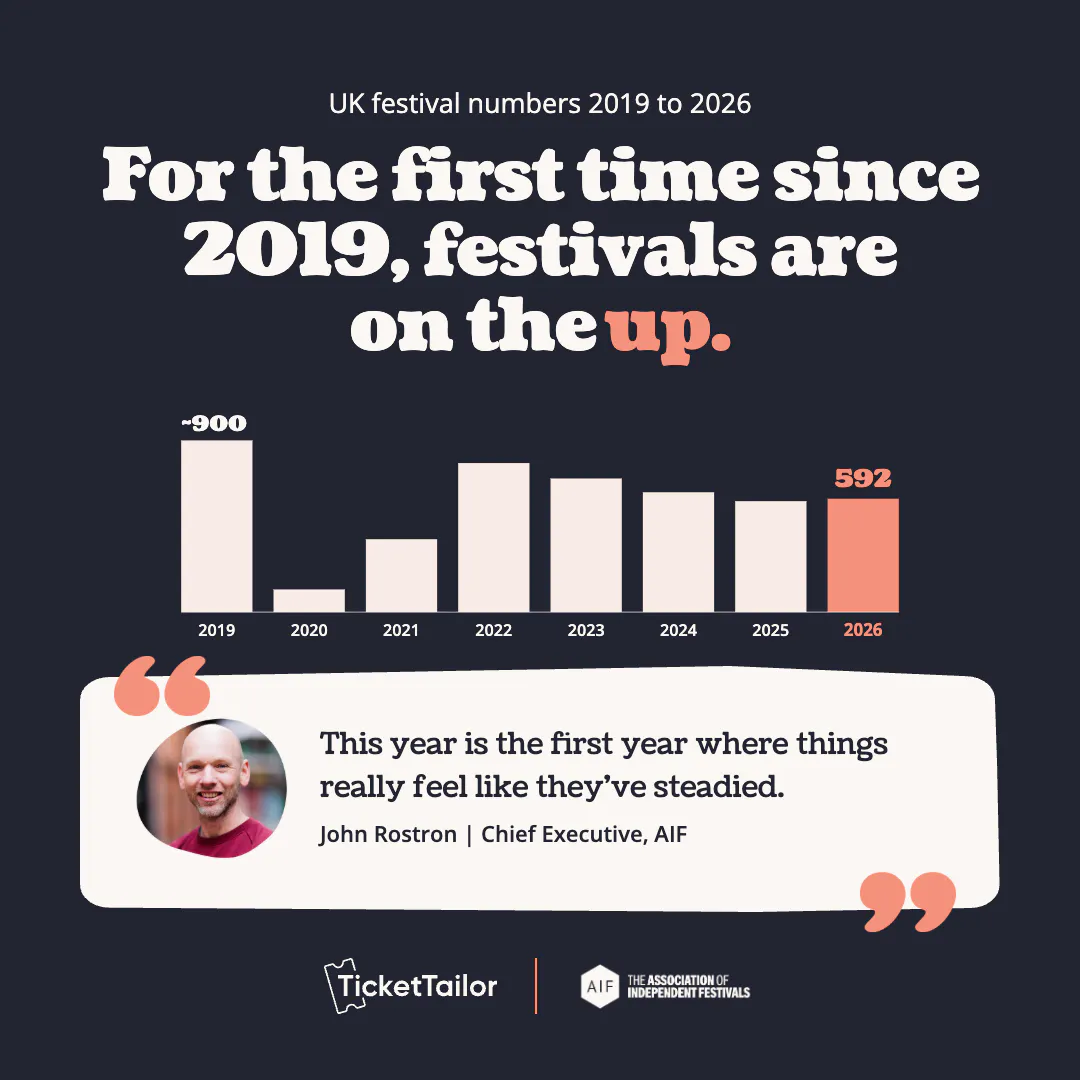
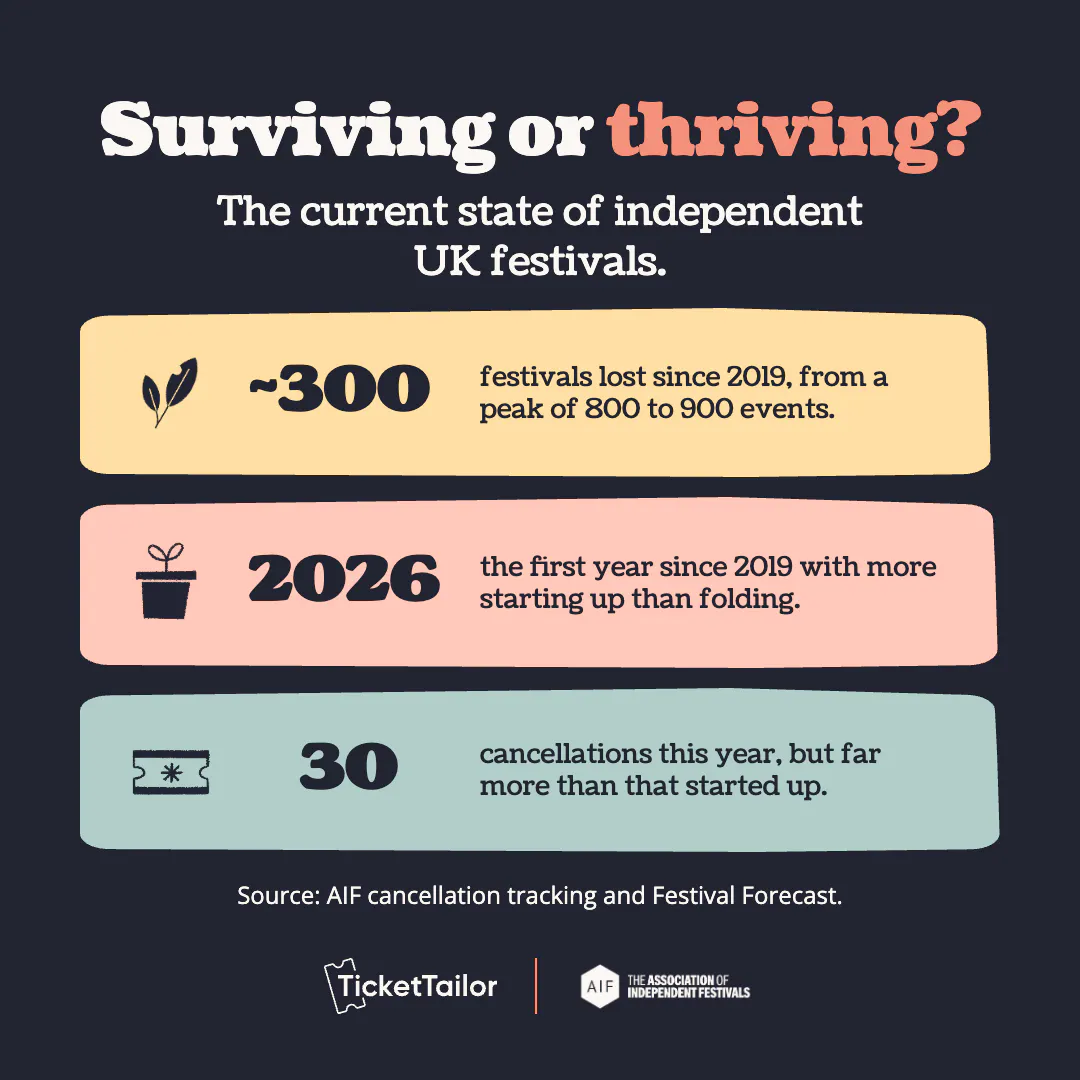
The first is that the losses since 2019 have been severe. According to AIF’s Festival Forecast 2025, the UK is now home to 592 music festivals, down from a 2018 and 2019 peak that AIF estimates at between 800 and 900. Around 300 events have gone.
The second is that the trend has turned. AIF chief executive John Rostron told us 2026 is "the first year where things really feel like they’ve steadied", and that more new festivals have started this year than have closed.
Which makes this a useful moment to ask a question that’s usually asked only in a crisis: when a festival fails, what actually kills it? Not the general answer, which is costs. The specific one.
What happened to the 300 lost festivals?
AIF’s own count, year by year, is at least 96 festivals lost between 2019 and 2022, 36 in 2023, 78 in 2024, and 40 by mid-2025. Rostron told us more than 30 have fallen this year.
AIF also breaks the surviving landscape down by size: 4 festivals are "major" at 80,000 capacity and above, 7 are "large" at 50,000 to 79,999, 33 are "medium" at 20,000 to 49,999, 334 are "small" at 1,000 to 19,999 and 214 are "micro" at under 1,000.
So 548 of the 592 festivals still running are under 20,000 capacity. The sector is overwhelmingly made up of small events, and it’s small events that absorbed most of the losses. That tells us who got hurt, but not yet why.
Festivals closing is never just one bad decision
Rostron took over at AIF in November 2022, which he describes as a period when he spent most of his time counting cancellations.
"I came in post-COVID, which everybody thought, great, we’re out of the pandemic, people are going to come. But as every festival organiser knows, they emerged out of the pandemic with debts."
What followed was cumulative. Debt carried over from the closed years, Brexit friction on visas, customs and crew, the war in Ukraine and the energy crisis, inflation across every supplier, and an audience whose behaviour nobody could yet predict.
"Festivals were cancelling left, right and centre. Hit with debts, rising costs, strange audience behaviour, people who’d bought tickets who didn’t turn up, young audiences that felt like we’d disappeared because guess what, they’d not been to a festival in their formative years."
Any one of those is survivable on its own, but they arrived together, and they landed on events that were already running on very little.
The costs that rose are the hardest to cut
AIF’s 2023 Festival Forecast described supply chain costs as having become "untenable, with increases over 30% since 2019, and in some areas as high as 80%". The categories it named were energy, production, staging and security.
Those are site costs, and site costs don’t scale down. You need a stage whether 400 people come or 4,000, and you need toilets, power, a perimeter, first aid and public liability insurance either way. When we dug into what a festival actually costs, site and infrastructure came out as the largest single block of spending and the least flexible.
Ticket prices, meanwhile, couldn’t move at the same speed. AIF’s 2023 forecast put overall ticket price rises across its membership at "around 12% since 2019", against those 30%-plus cost rises. Rostron’s summary to Pollstar: "They don’t want to pass that all on to customers, so they’ve raised ticket prices by 20% or so since COVID, and then looked at what can be cut to cover the rest."
Simon Clarke, director of Shindig in Somerset, told the BBC before the festival’s final edition in 2024: "Last year was the most expensive year to produce the event that we’ve ever had."
Which makes the unglamorous job the urgent one: work out which of your costs are genuinely variable, in a year when you don’t need to know.
Small margins leave little headroom
AIF’s 2023 figures had its members on course for £195 million of gross revenue against £177 million of gross expenditure. We make that a margin of roughly 9%. AIF don’t describe it as a margin themselves, and some members will have done much better and others much worse.
At that kind of margin, a festival’s entire annual result can be decided by weather, a headliner cancellation, a supplier failure or a slow on-sale.
It gets tighter when you look at break-even. Competitor platform tickts estimates that most festivals need to sell 70 to 85% of capacity to break even, and that the last 15 to 20% of ticket sales represents the majority of the profit. We haven’t been able to verify that against a primary source, so treat it as indicative, but it’s consistent with the margins AIF’s figures imply.
If that’s roughly right, the difference between a good year and a catastrophic one is a fairly small number of tickets sold at the very end of the on-sale. Reserves, in that light, aren’t idle money sitting in an account. They’re the thing that lets you absorb an ordinary piece of bad luck, and plenty of the festivals that went had none.
The money goes out before it comes in
Festival costs are front-loaded. Site deposits, staging, security, artist deposits and marketing all have to be paid in the months before the gates open, while most ticket revenue is still arriving.
That makes the pre-season window the point of maximum exposure. A festival can be entirely viable on paper and still fail because it ran out of cash in May.
Rostron cited improved cashflow support as one of the reasons the sector has stabilised, with more confidence from the wider industry in advancing cash to get festivals through the squeeze. The levers an organiser controls are the ones we covered in our piece on budgeting up: early tiers that bring revenue forward, payment plans, and year-round income like supporters schemes. Payment plans in particular are quick to set up if your platform supports them, and yes, ours does.
So the number worth modelling is your cash position month by month, not your profit for the year. And if your ticketing platform sits on your revenue until after the gates close, that could be a line worth renegotiating, or even a platform worth changing.
When festival costs rise, something has to make way
This something that unfolds over several years rather than one, and it’s the one organisers walk into with the best intentions.
When costs rise and prices can’t, something has to give. Rostron is direct about what usually goes:
"Often the first thing to go is a stage, and all the artists with it. Festivals always have way more on offer than people can see, and they often over-deliver, so the customer doesn’t notice any difference."
That quote holds both the risk and the reprieve, which is why we keep coming back to it. Most festivals genuinely do offer more than any one attendee can get through, so there’s usually more slack in a programme than organisers fear.
It only works once or twice, though. Cut a stage, then a programme strand, then the thing that made your site feel special, and eventually you’re selling a weaker festival at a higher price. Sales soften, which forces more cuts, which softens sales further.
The cuts that work are the ones your audience never experiences, which means keeping an honest list of what they actually came for. Not every festival that shrank had that list.
Cancellations change buying behaviour
In May 2025, Wannasee Ltd confirmed it was unable to continue and entered discussions with liquidators, citing a difficult trading environment and a "sudden collapse in customer confidence". The company had been running a portfolio of regional events, and its failure took the whole portfolio with it. Kubix and Monument in Sunderland, Wannasee South and Penrith, Jukebox in Sunderland and Bingley, Sign of the Times, three Stone Valley festivals and Northern Kin were all cancelled, nine festivals in a single week.
Ticket holders were left to seek refunds through their ticket providers or card issuers. Skiddle, which had sold tickets for several of the events, said its repeated requests to the organiser to release money for refunds had gone unheard, and offered affected customers credit or face-value refund requests.
The part that matters beyond Wannasee is what it does to everyone else. Every fan left out of pocket by a cancelled festival becomes a slightly more cautious ticket buyer next time, which raises the cost of trust for every organiser still trading.
If you run more than one event, it may be worth knowing how much of your risk is genuinely shared across them. And whoever you sell through, it’s worth knowing where the ticket money sits between the sale and the settlement, and what happens to it if things go wrong. We pay organisers directly via Stripe, Square or PayPal rather than holding ticket revenue until after the event, for exactly this reason.
A small mistake can stall your sales
Not every failure is structural. Rostron gave us an example that’s almost funny until you consider what it cost.
A festival got in touch with AIF because its ticket sales had stalled and nobody could work out why. When he looked at the festival’s own website, every ticket type was showing as sold out. They weren’t sold out. The tickets were listed on the ticketing platform’s site, but the festival’s own page was telling every visitor there was nothing to buy.
"Their ticket sales had stalled because it wasn’t on the website. Now it’s things like that, which we just find."
This is why he thinks external review matters. Peer networks are good at answering the questions you know to ask, and less good at the question you didn’t know existed.
So, worth trying: buy a ticket to your own festival once a month during the on-sale, from a device you’ve never used before. A live sales dashboard helps too, since a flatline is much easier to spot in your data than on a page you rarely look at yourself.
What the ones that survived did instead
The other side of the closure data is that most festivals came through. The same handful of behaviours kept appearing.
They sold early, to people who didn’t need convincing. Independents sell far more of their tickets on early bird than most, often before there’s any lineup to announce, which brings cash forward into the exposed months. Green Man has now sold out four years running, most recently in just over an hour, 11 months ahead and without announcing a single act, a pattern we explored in our piece on lineup versus community.
They made it easier to say yes. Payment plans came up unprompted as one of the changes Rostron thinks has mattered most: "It’s like, why didn’t we have that before? It’s such an obvious thing."
They resized rather than pushing on. Rostron described organisers "re-cutting their cloth" each year to match what they could actually deliver. Knockengorroch in Galloway is running 2026 as a deliberately smaller "Limited Edition" rather than attempting the same event with less money.
They asked their audience for help before it was too late. Knockengorroch raised £18,914 from its own community to cover increased costs rather than raising the gate price, then turned that into a year-round supporters scheme.
They built something worth rescuing. Lindisfarne Festival was one of the events caught in the Wannasee collapse, having been taken over by the company in 2024. It was saved by a new ownership group with founder Conleth Maenpaa returning as director, its 10th anniversary edition went ahead in 2025, previously purchased tickets remained valid, and it’s programmed again for September 2026. Maenpaa told the BBC he was "absolutely gutted" at the prospect of losing it, not only for attendees but for the staff, volunteers, traders and contractors who depend on it. His verdict on taking it back: "We can’t let something like this go to waste."
What made Lindisfarne rescuable wasn’t its balance sheet. It was that enough people wanted it to exist, including someone who knew exactly how to run it.
The cheapest insurance is an outside opinion
If you run an independent UK festival and any of the above sounds close to home, two things are worth doing. For what the festivals that are thriving are doing differently, our conversation with Rostron on the three things that separate them is worth reading too.
Join AIF if you haven’t. Rostron makes a claim about the value of the network that we’d report as his view rather than as published data: "Very few of our festivals fail compared to what fails outside, because there’s a lot of advice and support in there that you might not notice at the time, but it’s helping you down the line."
Then look at the Festival MOT, AIF’s newer service for festivals that are struggling, where industry experts come in and, in his words, "look under the bonnet" and give independent advice. Given how many of the above are invisible from the inside, that’s a cheap morning.
The tide does look like it has turned. The arithmetic underneath it hasn’t moved at all.
Further reading: